
How Long Does a Metal Roof Last in Florida?
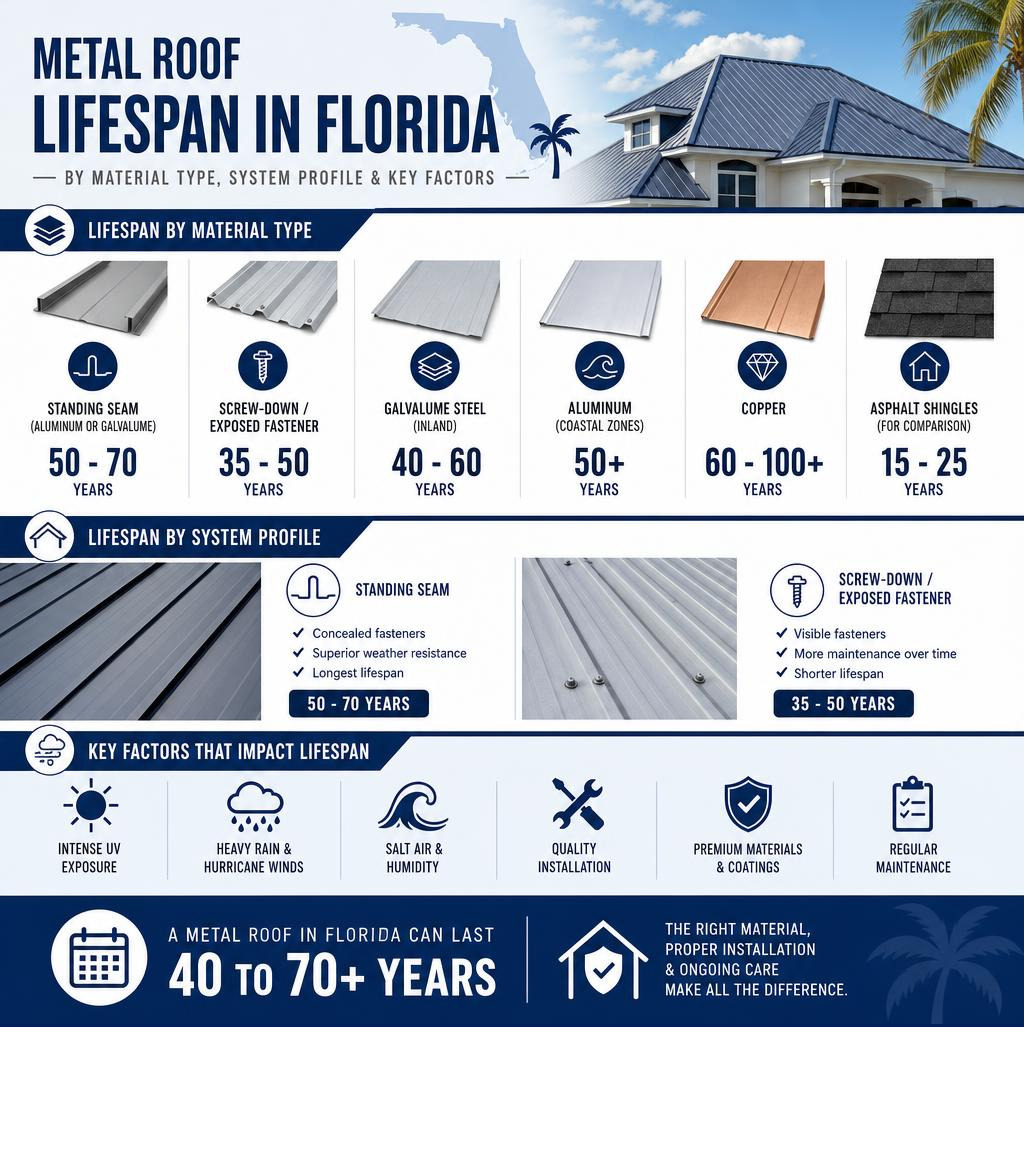
The lifespan of a metal roof in Florida typically ranges from 40 to 70 years, depending on the material, installation quality, and your home’s exposure to Florida’s climate. Here’s a quick breakdown:
| Metal Roof Type | Typical Lifespan in Florida |
|---|---|
| Standing seam (aluminum or Galvalume) | 50 – 70 years |
| Screw-down / exposed fastener | 35 – 50 years |
| Galvalume steel (inland) | 40 – 60 years |
| Aluminum (coastal zones) | 50+ years |
| Copper | 60 – 100+ years |
| Asphalt shingles (for comparison) | 15 – 25 years |
That’s 2 to 3 times longer than a typical asphalt shingle roof — often long enough to outlast your mortgage.
But the number alone doesn’t tell the whole story. Florida’s combination of hurricane-force winds, intense UV radiation, high humidity, and coastal salt air creates one of the most demanding roofing environments in the country. The same metal roof can last 70 years or fail in 20, depending on how it was installed, what material was used, and how well it’s maintained.
There’s also a lot of confusion floating around about Florida’s insurance rules — specifically the so-called “15-year roof rule” — and how it applies to metal roofs. Some contractors have used this rule to scare homeowners away from metal roofing entirely. That’s worth clearing up.
I’m Oscar Perez, founder of Anchor Up Roofing, and after years of installing and inspecting metal roofing systems across Miami-Dade, Broward, Palm Beach, and beyond, I’ve seen what separates a metal roof that hits 60+ years from one that’s struggling at 20. In this guide, I’ll walk you through everything you need to know about the lifespan of a metal roof in Florida — from materials and installation to insurance rules and maintenance.
Understanding the Lifespan of a Metal Roof in Florida
When we talk about the longevity of roofing materials, Florida is a different beast. In other parts of the country, a standard roof might cruise through decades of mild weather. In South Florida, our roofs face relentless sun, daily summer downpours, high humidity, and salt-laden ocean air.
Despite these challenges, metal roofing has emerged as the gold standard for homeowners looking to secure their property for the long haul. The Metal Roof Life Expectancy in Florida discussion among property inspectors and builders highlights a common theme: while traditional estimating charts often underestimate metal roofs, real-world field experience shows they consistently outperform other materials by decades. Understanding these dynamics is why more homeowners are realizing Why Metal Roofing is a Top Choice for Homeowners who want to buy their last roof.
How Climate and Location Affect the Lifespan of a Metal Roof in Florida
Several regional environmental factors work in tandem to degrade roofing systems in our state:
- Extreme UV Radiation and Heat: Florida roofs can easily reach surface temperatures exceeding 140°F during peak summer months. This intense heat accelerates the chemical breakdown of traditional roofing materials like asphalt shingles, causing them to curl, crack, and lose protective granules. Metal roofs reflect this heat and do not suffer from thermal degradation.
- High Humidity: Our average annual humidity sits around 74.5%. This constant moisture promotes condensation on surfaces, creating a prime breeding ground for rust and corrosion if the wrong materials or coatings are used.
- Salt Air Exposure: If you live within 3,000 feet of the ocean (and in South Florida, that covers a massive amount of real estate), salt-laden air accelerates the oxidation process. Salt acts as an electrolyte, dramatically speeding up the corrosion of standard steel components.
- Thermal Expansion and Contraction: As the sun heats the metal during the day and the roof cools down at night, the panels expand and contract. This constant physical movement puts immense stress on the fasteners, flashing, and seals.
Standing Seam vs. Exposed Fastener Systems
One of the most critical decisions affecting the lifespan of a metal roof in Florida is the system profile. Metal roofs generally fall into two categories: standing seam (concealed fasteners) and screw-down (exposed fasteners).
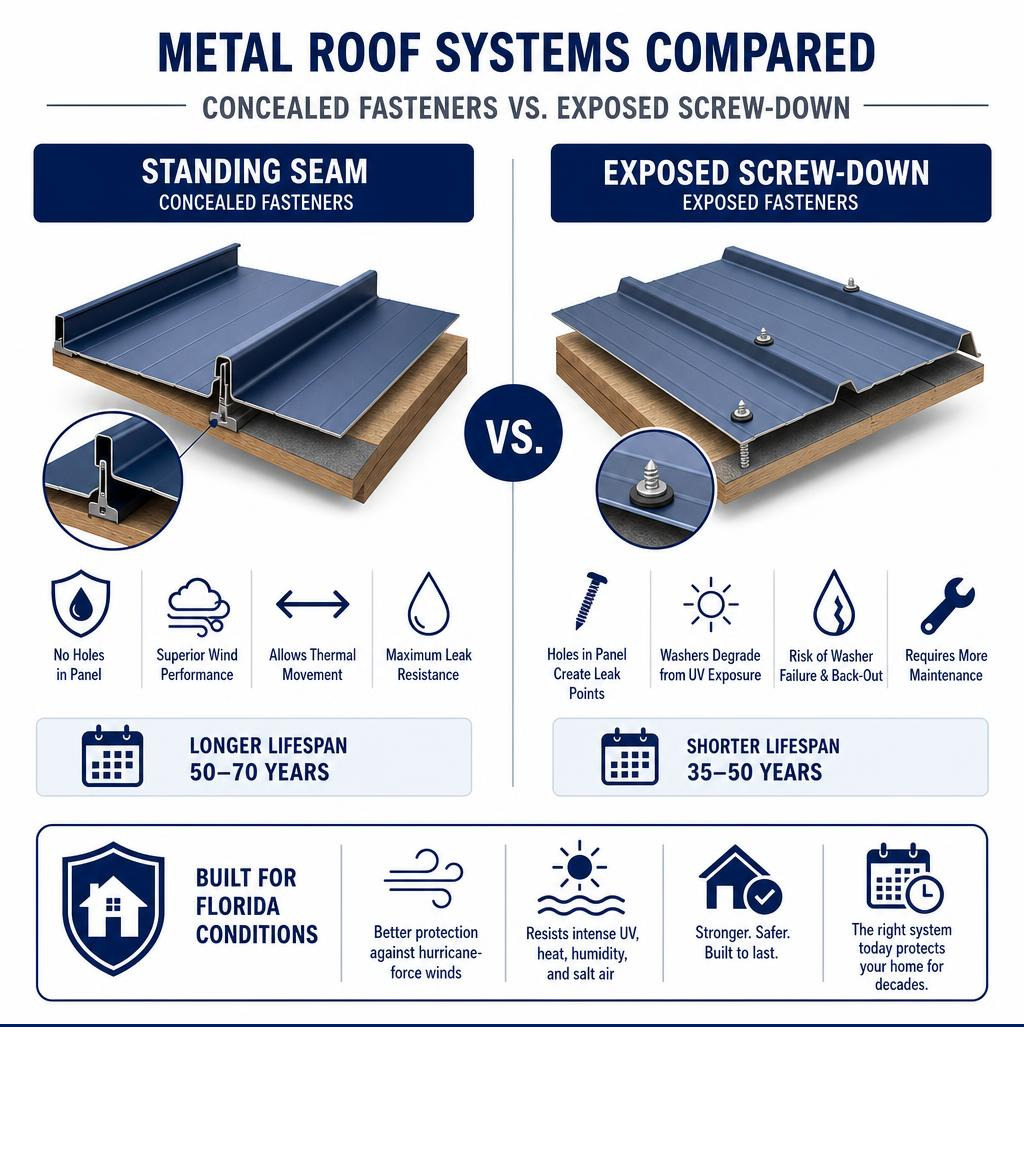
- Standing Seam Systems (50 to 70 Years): In a standing seam system, the fasteners are completely hidden under interlocking metal ribs. The panels are attached to the roof deck using floating clips that allow the metal to expand and contract freely without putting stress on the fasteners. Because there are zero holes punched through the metal panels themselves, the risk of leaks is virtually eliminated. For a deeper look at how these systems are built, check out The Ultimate Beginner Guide to Metal Roof Construction.
- Screw-Down / Exposed Fastener Systems (35 to 50 Years): Often referred to as R-panels or 5V-crimp, these systems are installed by driving thousands of screws directly through the metal panels and into the wood decking. Each screw relies on a small neoprene or rubber washer to seal the hole. Over time, Florida’s intense UV rays degrade these washers, causing them to dry rot, crack, and back out. This means that while the metal panels themselves may still be in perfect condition, the system can fail and leak due to fastener degradation, requiring complete re-screwing every 15 to 20 years.
Material Matters: Aluminum, Galvalume, and Copper
The base metal you choose dictates how your roof will handle the elements, especially if you live near the coast. Choosing the right metal is key to maximizing your investment, as detailed in our guide on the Best Residential Metal Roofing Options.
- Aluminum (50+ Years): Aluminum is the absolute king of coastal roofing. Unlike steel, aluminum does not rust. When exposed to the atmosphere, it naturally forms a protective oxide layer that seals the metal from further corrosion. If you live within 1,500 feet of the saltwater coastline, aluminum is highly recommended.
- Galvalume Steel (40 to 60 Years): Galvalume is steel coated with an alloy of aluminum and zinc. This combination offers the strength of steel with the barrier protection of aluminum and the sacrificial protection of zinc. It performs phenomenally well inland, but can experience accelerated edge rust near salt water where cut edges are exposed.
- Copper (60 to 100+ Years): Copper is a premium, timeless metal that naturally develops a beautiful green patina over time. This patina acts as an impenetrable shield against corrosion. Copper roofs can literally last a century, though they are a highly specialized, costly option reserved for specific architectural styles.
Debunking the 15-Year Roof Rule: Florida Statute § 627.7011(5)
If you’ve spent any time talking to neighbors or browsing Florida real estate forums, you’ve probably heard of the dreaded “15-year roof rule.” Some shingle-focused contractors have used this rule to scare homeowners, claiming that insurance companies will force you to replace any roof after 15 years, so buying a long-lasting metal roof is a waste of money.
This is simply not true. Let’s look at what the law actually says.
How the 15-Year Rule Impacts the Lifespan of a Metal Roof in Florida
In 2022, the Florida Legislature passed Senate Bill 2-D, which created Florida Statute § 627.7011(5). This law was specifically written to protect homeowners from arbitrary insurance cancellations based solely on the age of their roof.
According to the statute:
- Under 15 Years: If your roof is less than 15 years old, an insurance company cannot refuse to issue or renew a homeowner’s policy solely because of the roof’s age.
- 15 Years and Older: If your roof is 15 years or older, the insurer still cannot deny coverage based on age alone if the homeowner provides a professional roof inspection showing that the roof has at least 5 years of remaining useful life.
This is a massive win for metal roofs. Because metal roofs are incredibly durable, a 15-year-old or even a 30-year-old standing seam metal roof will easily pass an inspection and prove it has 5+ years of remaining useful life. You can read more about how this legislation protects metal roof owners in Florida’s 15-Year Roof Rule: Metal Roofing Facts.
Insurance Treatment: Coverage, Discounts, and Wind Mitigation
Far from penalizing you, Florida insurance carriers actually prefer metal roofs because they significantly reduce the risk of catastrophic storm damage.
When we install a metal roof, we perform a wind mitigation inspection. Because metal roofs are fastened securely to the home’s structure and feature continuous interlocking panels, they may qualify for valuable wind mitigation credits. Many Florida insurance providers offer premium discounts for homes with certified, hurricane-rated metal roofs. Over the lifetime of the roof, these annual savings can add up, helping to offset the initial cost of installation.
Key Factors Influencing Metal Roof Longevity
A metal roof’s lifespan isn’t just about the metal itself; it’s about the entire engineered system working together.
Coastal vs. Inland Environmental Degradation
Proximity to the ocean is the single biggest environmental variable for metal roofs in South Florida.
- Inland Properties: If your home is located several miles inland (for example, in inland parts of Miramar, Pembroke Pines, or Hialeah), salt spray is less of a concern. Here, Galvalume steel with a high-quality PVDF (Kynar 500) coating will easily reach its 50-to-60-year potential.
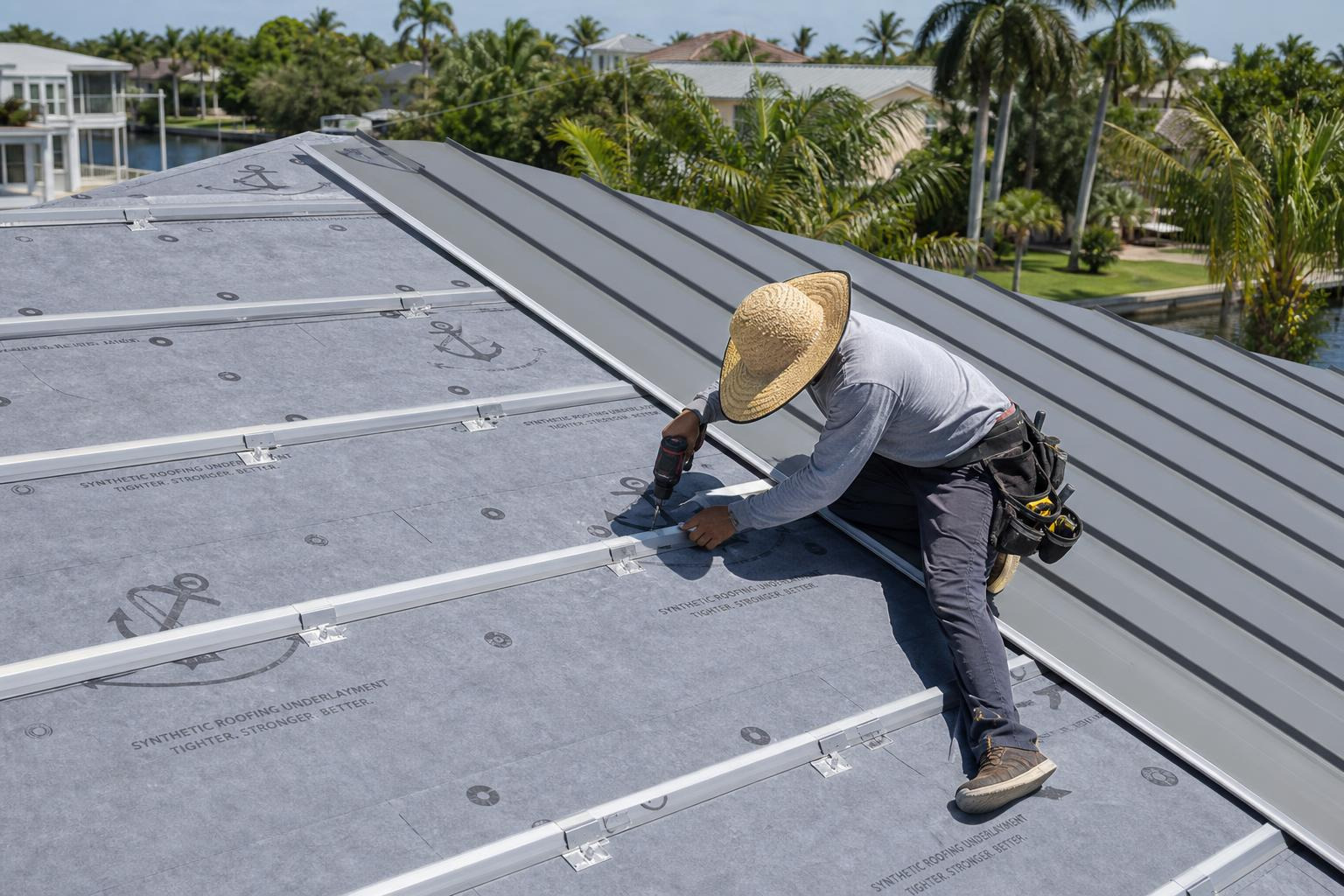
- Coastal Properties: If you are within a mile of the Atlantic or the Gulf, salt mist will settle on your roof daily. Standard steel will rust quickly once the protective coating is compromised. For coastal environments, marine-grade aluminum or copper is essential, along with stainless steel fasteners to prevent galvanic corrosion (which occurs when two dissimilar metals react in a wet, salty environment).
Florida Building Code and HVHZ Requirements
South Florida has some of the strictest building codes in the world, particularly within the High-Velocity Hurricane Zone (HVHZ), which covers Miami-Dade and Broward counties.
To comply with the Florida Building Code, any metal roofing system installed in these zones must carry a valid Miami-Dade Notice of Acceptance (NOA) or Florida Product Approval. These systems are subjected to rigorous testing (such as UL 580 and TAS 125) to ensure they can withstand extreme wind uplift forces. To ensure your home is fully prepared for our active storm seasons, review our guide on Learn How to Prepare Your Roof for Hurricane Season in Florida.
Metal vs. Shingles: Long-Term Performance and Cost of Ownership
If you are debating whether to stick with asphalt shingles or make the jump to metal, it helps to look at the long-term numbers. If you’re wondering about the logistics of making the transition, read about how Can You Switch from Shingles to Metal Roofing.
| Feature | Asphalt Shingles | Standing Seam Metal |
|---|---|---|
| Average Lifespan | 15 – 25 Years | 50 – 70 Years |
| Wind Resistance | 110 – 130 mph | 140 – 160+ mph (Up to 200 mph) |
| UV Resistance | Poor (Degrades, loses granules) | Excellent (Reflective coatings) |
| Algae/Mildew Risk | High (Black streaks common) | Low (Easily washed) |
| Upfront Cost | Budget-friendly | Costly |
| Replacements Needed (50 Yrs) | 2 to 3 replacements | 0 replacements |
| Recyclability | Ends up in landfill | 100% Recyclable |
Hurricane Resistance and HOA Regulations
During a major hurricane, asphalt shingles fail when wind gets underneath them, lifting and tearing them away from the deck. Once shingles are gone, water pours into the home, causing catastrophic interior damage.
Metal roofing panels are interlocked and anchored directly to the roof deck. A properly installed standing seam metal roof can withstand sustained winds of 140 mph and gusts up to 180 mph or higher. We’ve seen neighborhoods where every shingle roof was stripped bare by storm winds, while the metal roofs remained completely intact.
Historically, some Homeowners Associations (HOAs) banned metal roofs because they preferred a uniform, traditional look. However, Florida law has evolved to protect homeowners. HOAs generally cannot arbitrarily ban metal roofs, especially if the homeowner selects a style that mimics traditional tile or shingles (like stone-coated metal) or if the metal roof meets the state’s energy-efficiency goals. The Benefits of a Metal Roof in terms of storm safety and durability are now widely recognized by insurers and local municipalities alike.
Lifecycle Cost Analysis: Metal vs. Shingles
While a metal roof is more costly upfront than asphalt shingles, it is almost always the more economical choice over the life of your home.
Consider this: if you install a shingle roof today, you will likely have to replace it at least once, if not twice, over the next 50 years. Each replacement means paying for labor, materials, permitting, and disposal fees all over again. With a standing seam metal roof, you pay for installation once.
Additionally, metal roofs are highly reflective. When treated with “cool roof” PVDF coatings, they can reflect up to 90% of solar radiation. This reduces the heat transferred into your attic, lowering your air conditioning cooling load. Over decades of hot Florida summers, these energy savings are substantial. Discover more about this in our article on Does Metal Roofing Improve Home Energy Efficiency.
Maintenance and Preventing Common Failure Points
While metal is incredibly durable, it is not completely maintenance-free. To get the full 60+ years out of your roof, you need to perform basic preventative care and understand where systems are most vulnerable. Read our complete guide on the Low Maintenance Metal Roofs in South Florida to learn more about keeping your system in top shape.
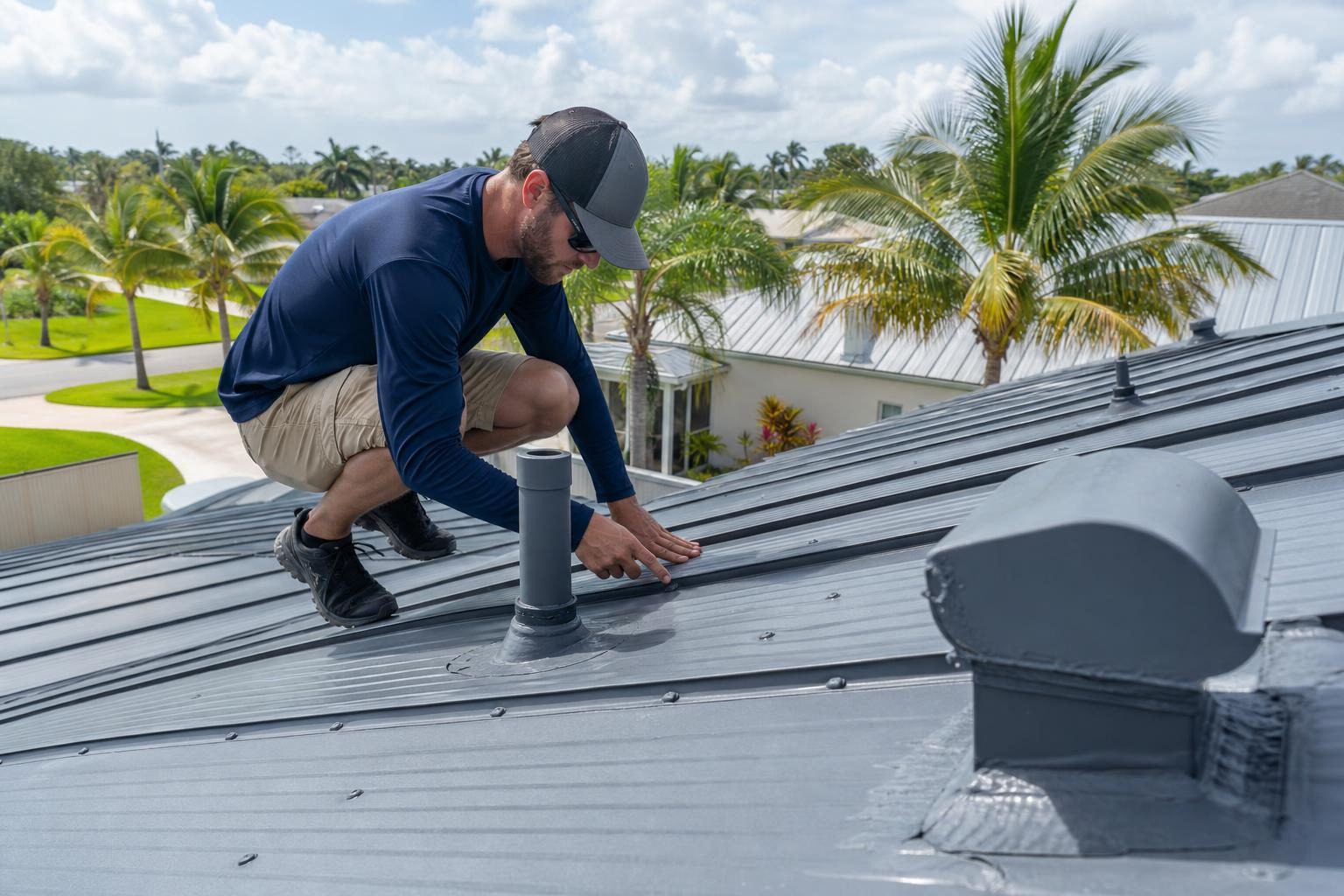
Preventing Fastener, Flashing, and Corrosion Failures
A metal roof rarely fails because the metal panels themselves wear out. Instead, failures almost always start at the connection points:
- Fasteners and Washers: On exposed fastener systems, the neoprene washers will eventually dry rot. They must be inspected and replaced every 15 to 20 years to prevent slow leaks that can rot the wood decking underneath.
- Flashing and Penetrations: Flashing around chimneys, skylights, and valleys is where water is funneled. If the flashing is poorly sealed or if different metals are allowed to touch, corrosion will occur.
- Cut Edges and Cut Tailings: During installation, panels are cut to fit. If the raw, cut steel edges are not treated or coated, they will rust. Furthermore, metal shavings (tailings) left on the roof during installation can rust and create ugly pockmarks on the paint finish. A professional installer will always sweep the roof clean of all metal debris.
Recommended Inspection and Maintenance Schedule
To maximize your roof’s lifespan, we recommend a simple, proactive maintenance routine:
- Annual Visual Inspection: Before the start of hurricane season (June 1st), do a visual scan of your roof. Look for loose trim, backed-out screws, or accumulated debris in the valleys.
- Post-Storm Checks: After any major storm or high-wind event, inspect the perimeter of your roof to ensure no trim or flashing has lifted.
- Keep it Clean: Remove leaves, branches, and organic debris from valleys and gutters. Trapped wet debris holds moisture against the metal, which can eventually break down the protective coatings.
- Freshwater Rinses (Coastal Only): If you live within a mile of the ocean, rinsing your roof with fresh water twice a year helps wash away corrosive salt deposits, extending the life of your coatings.
For a detailed comparison of maintaining different high-end roofing systems, check out our guide on Maintenance of Metal and Tile Roofs to Find the Best Option for Your Florida Home.
Frequently Asked Questions about Metal Roof Longevity
Can a metal roof last 70 years in coastal Florida?
Yes. A standing seam aluminum roof with a premium PVDF (Kynar 500) coating can easily reach 60 to 70 years of service, even when exposed to salt air. Aluminum’s natural resistance to rust makes it the ideal choice for coastal properties.
Will a metal roof lower my insurance premium in Florida?
In most cases, yes. Because metal roofs offer superior wind uplift resistance and carry high fire and impact ratings, Florida insurance carriers typically offer wind mitigation discounts that can significantly lower your annual premiums.
How often should a metal roof be inspected in Florida?
We recommend having your metal roof professionally inspected once a year, preferably in the spring before hurricane season begins, and immediately following any major storm.
Conclusion
Investing in a metal roof is one of the smartest decisions you can make to protect your home and family in South Florida. With a realistic lifespan of 40 to 70 years, unmatched wind resistance, and excellent energy efficiency, a quality metal roof provides peace of mind that traditional shingles simply cannot match.
At Anchor Up Roofing, we are proud to be a retired veteran-owned business with over 20 years of hands-on roofing experience in South Florida. We don’t believe in cutting corners, and we don’t believe in high-pressure sales tactics. We focus on providing top-tier craftsmanship, transparent communication, and flexible financing options to help you secure your home for the long haul.
Whether you are in Miami-Dade, Broward, Fort Myers, Naples, or anywhere along Florida’s coasts, we are here to help. Schedule a metal roofing consultation with our expert team today, and let’s build a roof that stands the test of time.