
Why Commercial Flat Roofs Are One of the Biggest Roofing Decisions You’ll Make
Commercial flat roofs cover millions of square feet of business space across the United States — from warehouses and retail stores to office buildings and medical centers. If you manage or own a commercial property, your roof is likely one of the most expensive assets you’re responsible for.
Quick answer: What are commercial flat roofs?
| Feature | Details |
|---|---|
| Slope range | ¼:12 to 3:12 (low-slope, not truly flat) |
| Common materials | TPO, EPDM, PVC, BUR, Modified Bitumen |
| Typical lifespan | 20–35 years depending on material |
| Installed cost range | $5–$12 per sq. ft. depending on system |
| Most common uses | Warehouses, offices, retail, schools, hospitals |
| Key advantage | Lower construction cost + usable rooftop space |
| Biggest risk | Ponding water if drainage is poorly designed |
These roofs are not completely flat. They have a slight slope — typically between ¼ and 3 inches of rise per 12 inches of run — designed to move water toward drains, scuppers, or gutters. That small detail matters more than most people realize.
Choosing the wrong system, or hiring the wrong contractor, can mean years of leaks, costly repairs, and headaches during Florida’s storm season. This guide walks you through everything — materials, costs, lifespan, maintenance, and what to look for in a contractor.
I’m Oscar Perez, founder of Anchor Up Roofing, and I’ve spent years helping commercial property owners across South Florida select, install, and maintain commercial flat roofs built to handle heat, humidity, and hurricanes. In this guide, I’ll share what we’ve learned working across Miami-Dade, Broward, Palm Beach, and beyond so you can make a confident, informed decision.
What Commercial Flat Roofs Are and Why Businesses Choose Them
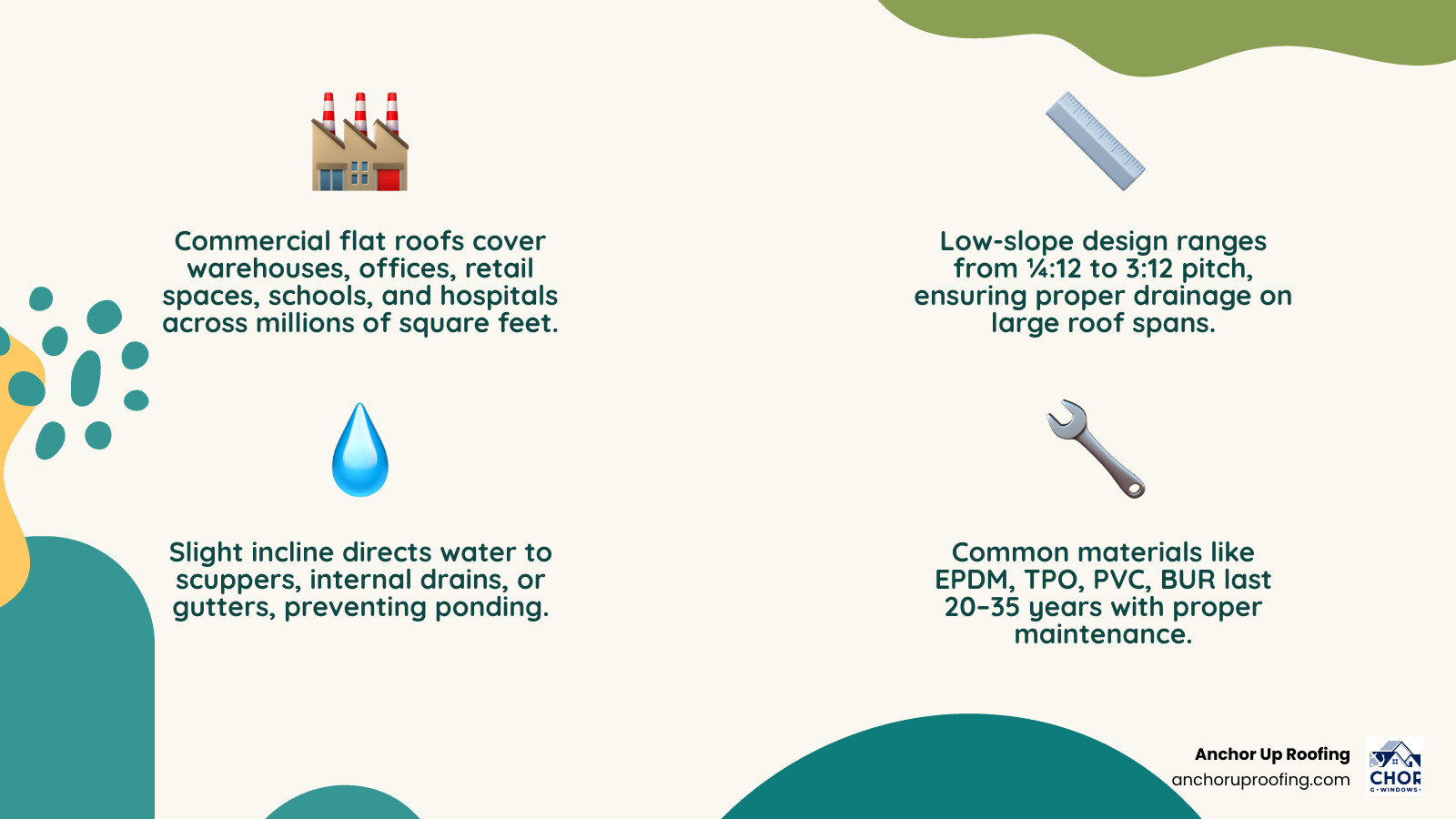
In commercial construction, “flat” is a bit of a misnomer. These systems are technically low-slope roofs, typically featuring a pitch ranging from ¼:12 to 3:12. This subtle incline is the secret to their success, ensuring that even on a massive 50,000-square-foot warehouse, gravity can still do its job.
How commercial flat roofs differ from steep-slope roofs
Unlike the pitched roofs you see on most homes, commercial flat roofs are designed to cover vast spans without the need for high peaks. While residential roofs rely on overlapping materials like shingles or tiles to shed water quickly, flat roofs use continuous membrane systems or multi-ply barriers to create a watertight seal. This allows for much larger building footprints and simplifies the structural requirements for the decking below.
Why commercial buildings commonly use flat roofs
There are several reasons why you rarely see a “pointy” roof on a big-box store or an office park:
- Construction Savings: Flat roofs require less material and are generally faster to install over large areas, saving on both labor and supplies.
- Equipment Space: In South Florida, we need heavy-duty HVAC systems. A flat roof provides the perfect platform for cooling towers, solar panels, and satellite equipment, keeping them out of sight and off the ground.
- Usable Space: Some businesses transform their roofs into employee lounge areas, rooftop gardens, or additional storage.
- Accessibility: It is much safer and easier for technicians to walk on a flat surface to maintain units or inspect the roof than it is to navigate a steep incline.
The building science behind drainage on low-slope roofs
Drainage is the single most important factor in the health of a flat roof. Without it, you get “ponding water”—standing water that stays on the roof for more than 48 hours. This extra weight can stress the structure and accelerate membrane degradation.
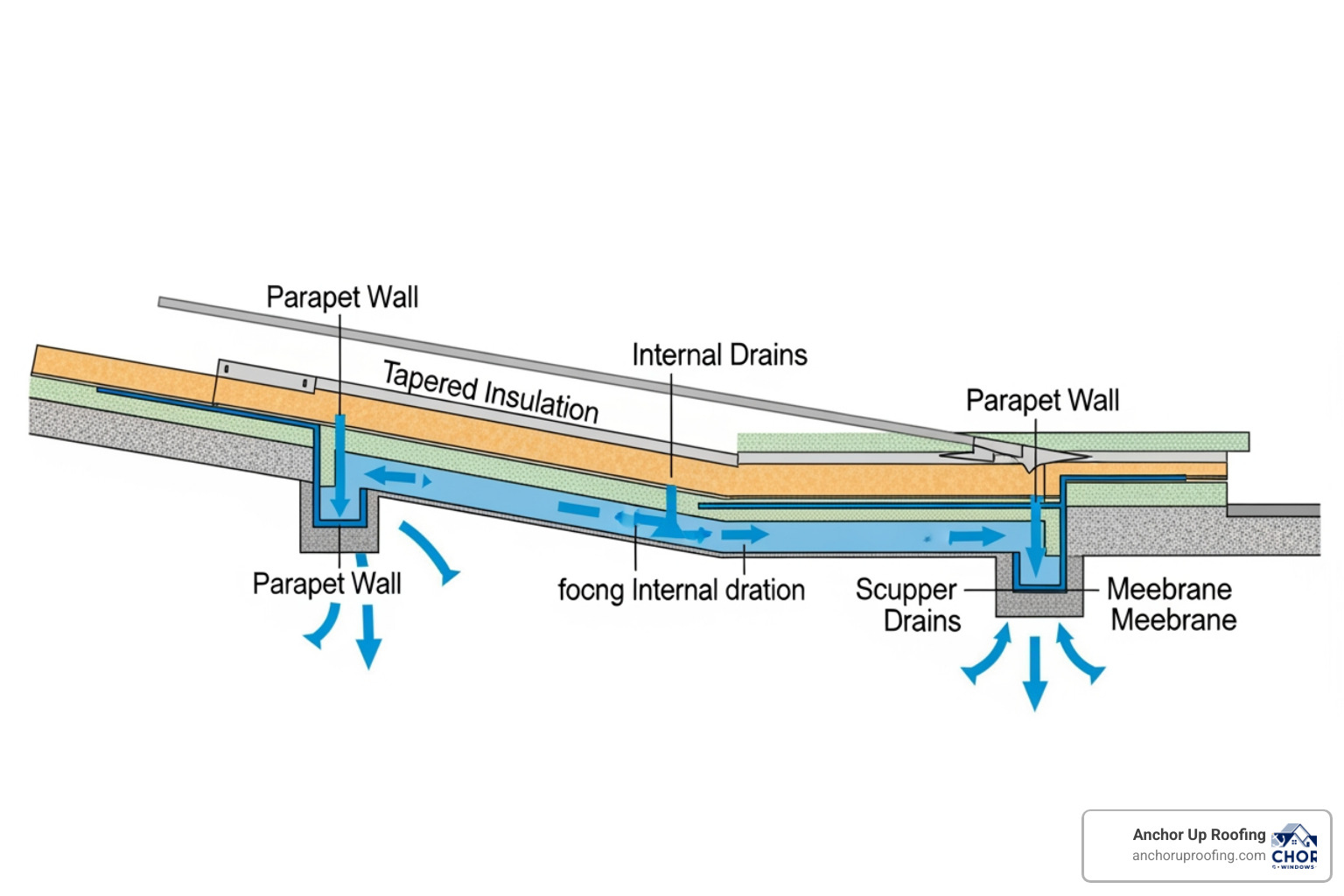
To prevent this, we use positive drainage techniques. This often involves tapered insulation, which is cut at an angle to create artificial slopes toward the drains. Water is then directed to:
- Internal Drains: Pipes located in the center of the roof that lead water through the building’s interior.
- Scuppers: Openings in the parapet walls that allow water to exit to exterior downspouts.
- Gutters: Mounted at the roof edge to catch runoff.
Types of Commercial Flat Roofs and Where Each System Fits Best
Choosing the right material is like choosing the right tires for your car; it depends on where you’re driving and how much weight you’re carrying. Here is how the major systems stack up.
| System Type | Best For | Key Advantage | Market Share (Approx.) |
|---|---|---|---|
| TPO | Retail & Offices | Energy efficiency/Cool roof | 40% (New) / 30% (Reroof) |
| EPDM | Large Warehouses | Extreme durability/Lifespan | 22% (New) / 26% (Reroof) |
| Modified Bitumen | High-traffic roofs | Puncture resistance | 12.4% (New) / 14% (Reroof) |
| PVC | Restaurants/Industrial | Chemical & grease resistance | High for specialty use |
| BUR (Built-Up) | Traditional buildings | Redundant layers | Proven track record |
EPDM for commercial flat roofs
EPDM (ethylene propylene diene monomer) is a synthetic rubber membrane that has been a staple in the industry for decades. It is incredibly flexible, meaning it can expand and contract as the Florida sun heats it up and the afternoon rain cools it down. EPDM is often installed in large sheets, which minimizes seams—the most common point of failure. It can be fully adhered with glue, mechanically fastened with screws, or ballasted with heavy stone. You can find more details on Commercial EPDM systems explained.
TPO and PVC membranes for energy efficiency and durability
TPO (Thermoplastic Polyolefin) and PVC (Polyvinyl Chloride) are the “cool kids” of the roofing world. These white, reflective membranes are highly sought after in Miami and Fort Myers because they bounce UV rays back into the atmosphere, significantly lowering cooling costs.
- TPO: One of the fastest-growing options due to its balance of cost and performance. Its seams are heat-welded, creating a bond stronger than the membrane itself.
- PVC: Similar to TPO but with a superpower—it is highly resistant to chemicals, oils, and animal fats. This makes it the gold standard for restaurants (where grease vents onto the roof) and industrial facilities.
BUR and Modified Bitumen for proven multi-layer protection
If you prefer “old school” reliability, Built-Up Roofing (BUR) and Modified Bitumen are multi-ply systems. BUR uses alternating layers of bitumen (asphalt) and reinforcing fabrics. Modified Bitumen takes that a step further by adding polymers to the asphalt for better elasticity. These systems are “redundant,” meaning if the top layer is punctured, the layers beneath it still provide protection. They are excellent for roofs that see a lot of foot traffic from HVAC technicians.
Choosing by building use, climate, and exposure
In South Florida, we have to worry about wind uplift. During a hurricane, wind tries to peel the roof off like the lid of a tin can. We always recommend systems that meet strict Miami-Dade or Broward County codes. For buildings near the coast, salt-air resistance is a must. If you are trying to decide which fits your specific property, check out our page on Commercial Roofing.
Costs, Lifespan, and Return on Investment for Commercial Flat Roofs
That factors like the height of the building, the complexity of the rooftop equipment, and whether we have to perform a full “tear-off” of the old roof will influence these numbers.
Expected lifespan of major flat roofing systems
How long will your investment last? With proper maintenance, here are the averages:
- EPDM: 25–35 years
- BUR: 20–30 years
- TPO: 20–30 years
- PVC: 25–30 years
- Modified Bitumen: 20–25 years
What affects lifespan most
The Florida climate is brutal. UV exposure is the silent killer of roofing membranes, causing them to become brittle over time. However, the #1 cause of premature failure is installation quality. If the seams aren’t welded correctly or the flashing around a vent is sloppy, the roof won’t make it to year ten. Other factors include poor drainage (ponding water) and excessive foot traffic that causes punctures.
Repair, restoration, overlay, or replacement?
You don’t always need a brand-new roof.
- Repair: Best for isolated leaks on roofs under 10–15 years old.
- Restoration/Coating: If the membrane is mostly sound but aging, a liquid-applied coating can add 10 years of life at a fraction of the cost.
- Overlay: Sometimes we can install a new membrane over the old one, saving you the cost of a tear-off. However, building codes usually limit you to two roof layers.
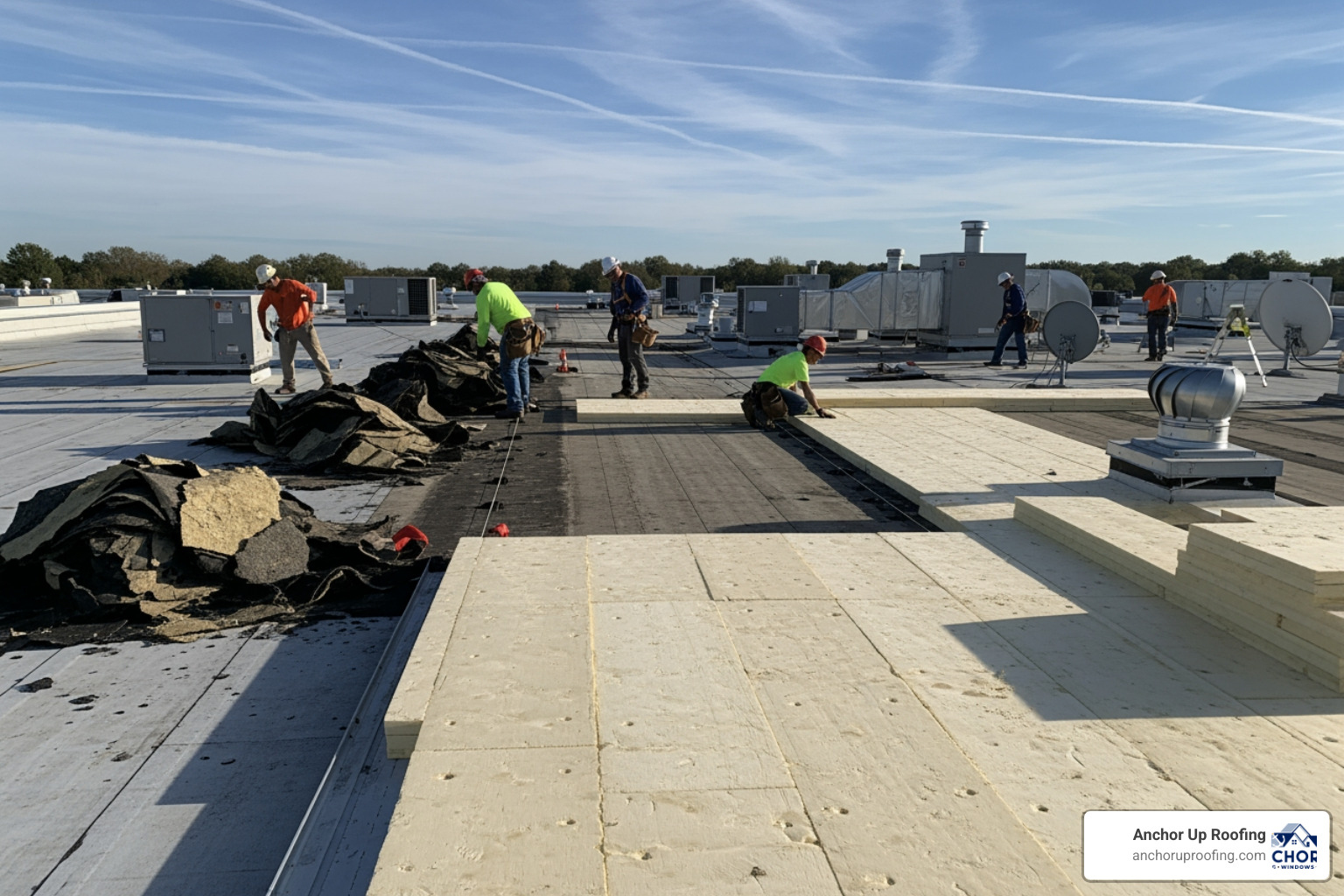
- Replacement: Necessary if the insulation is wet, the deck is damaged, or the roof has exceeded its functional life. Learn more about the process of Flat Roof Installation.
Common Problems With Commercial Flat Roofs and How to Prevent Them
Even the best roofs can run into trouble. Knowing what to look for can save you thousands in emergency repairs.
The most common failure points on commercial flat roofs
Leaks rarely start in the middle of a flat open space. They almost always happen at:
- Penetrations: Around HVAC curbs, vents, and pipes.
- Parapet Walls: Where the roof meets the wall; the flashing here can pull away.
- Edge Metal: If the perimeter metal isn’t secure, wind can catch it and tear the membrane.
- Field Seams: If the glue or heat-weld fails, water finds a way in.
Preventing water intrusion and storm-related damage
In South Florida, “storm-ready” means more than just having a roof. It means ensuring your fastener patterns meet hurricane codes and your perimeters are reinforced. We often perform moisture scans (using infrared technology) to find hidden water trapped under the membrane before it causes structural rot.
Routine maintenance that extends roof life
Proactive maintenance can extend a flat roof’s life by 5 to 10 years. We recommend a “Spring and Fall” inspection schedule. Our Commercial Roof Inspection Checklist includes:
- Clearing debris from drains and scuppers.
- Checking for “alligatoring” (cracking) on asphalt surfaces.
- Inspecting sealants around penetrations.
- Looking for blisters or bubbles (signs of trapped moisture).
Energy efficiency, cool roofs, and coatings
Modern commercial flat roofs are tools for energy conservation. A “Cool Roof” uses a highly reflective surface to stay up to 50°F cooler than a traditional dark roof. This reduces the load on your HVAC units, leading to lower monthly bills and a longer lifespan for your cooling equipment. For a deeper dive into materials, check out A complete guide to low-slope roofing materials.
Installation Methods, Warranties, and Hiring the Right Contractor
The way a roof is attached to your building is just as important as the material itself.
Which installation method is best for each scenario?
- Fully Adhered: The membrane is glued to the insulation. This is great for high-wind areas like Miami because there are no fasteners to pull through the membrane.
- Mechanically Fastened: The membrane is screwed into the deck. It’s fast and cost-effective but can be noisier during installation.
- Ballasted: The membrane is laid down and held in place by large stones or pavers. This is less common in hurricane zones due to the risk of “flying gravel.”
What a good commercial flat roof warranty should cover
Don’t just look at the number of years; look at the type of warranty.
- Material Warranty: Only covers defects in the product itself.
- Labor/Workmanship Warranty: Covers the contractor’s mistakes.
- NDL (No Dollar Limit) Warranty: These are the gold standard. They are backed by the manufacturer and cover both labor and materials for the full term, with no cap on the repair cost.
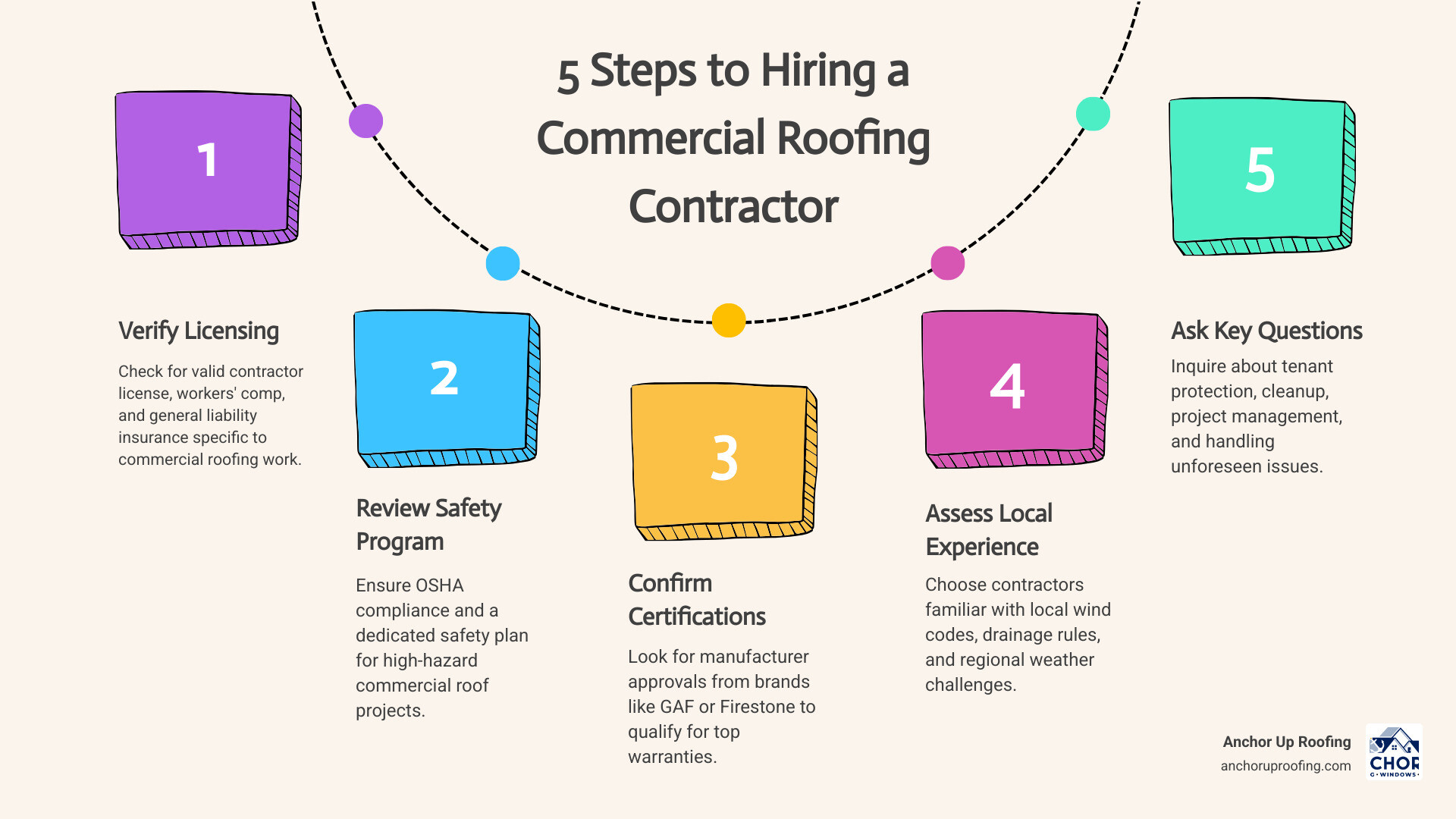
What to look for in a commercial roofing contractor
Hiring an unlicensed or “fly-by-night” roofer is a massive liability risk. Always verify:
- Licensing and Insurance: Ensure they have workers’ comp and general liability specifically for commercial work.
- Safety Program: Commercial roofs have unique hazards; the crew should be OSHA-compliant.
- Manufacturer Certifications: Top-tier manufacturers like GAF or Firestone only allow certified contractors to offer NDL warranties.
- Local Experience: A contractor from out of state might not understand the specific drainage or wind-code requirements of Sarasota or Lee County.
Questions to ask before signing a roofing contract
- How will you protect our tenants/customers during the project?
- What is your plan for daily cleanup?
- Do you have a dedicated project manager who will be on-site?
- How do you handle “unforeseen” deck damage once the old roof is off?
Frequently Asked Questions About Commercial Flat Roofs
How often should commercial flat roofs be inspected?
At a minimum, twice a year—once before the rainy season and once after. You should also have a professional look at the roof after any major storm or if you’ve had other trades (like HVAC or solar) working on the roof.
Which flat roof system is best for a hot, hurricane-prone climate?
In South Florida, TPO is incredibly popular because of its heat reflectivity. However, a multi-ply Modified Bitumen system is often preferred for its sheer toughness against wind-blown debris. The “best” system is the one installed to Miami-Dade NOA (Notice of Acceptance) standards.
When is a repair enough and when is replacement smarter?
If your roof is under 15 years old and the leak is isolated to one area, a repair is usually fine. If you are chasing multiple leaks, the insulation is saturated, or the membrane has become brittle and “crusty,” you are throwing good money after bad by repairing it. At that point, replacement is the smarter long-term move.
Conclusion
Choosing and maintaining commercial flat roofs doesn’t have to be a headache. By understanding the materials, keeping up with drainage, and partnering with a contractor who knows the Florida landscape, you can turn your roof into a long-term asset rather than a constant liability.
At Anchor Up Roofing, we bring over 20 years of experience and a veteran’s eye for detail to every project. Whether you are in Naples, Hialeah, or Sarasota, we are here to help you protect your business. If you’re ready to discuss your options or need a professional inspection, take a look at our specialized page on Flat Roofs and let’s get your business covered.