

Why Residential Gutter Installation Is One of the Most Important Home Protection Decisions You’ll Make
Residential gutter installation is the process of fitting a drainage system along your roofline to carry rainwater safely away from your home’s foundation, siding, and landscaping.
Quick Answer: What You Need to Know About Residential Gutter Installation
- Choose your material — Aluminum is the most popular choice for most homes; copper is premium; vinyl is budget-friendly but less durable in extreme heat.
- Pick your gutter type — Seamless gutters have far fewer leak points than sectional; they’re custom-made on-site to fit your home exactly.
- Get the size right — Most homes use 5-inch gutters; larger roofs or high-rainfall areas (like South Florida) often need 6-inch.
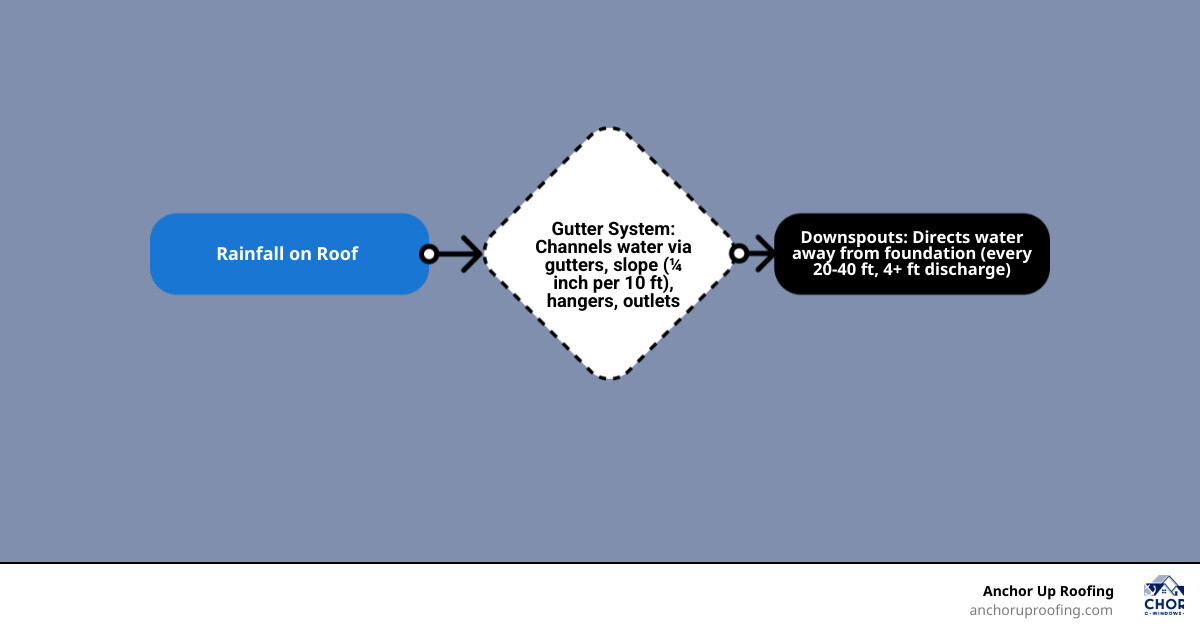
- Nail the slope — Gutters must drop ¼ inch for every 10 feet toward the downspout so water drains instead of pooling.
- Place downspouts correctly — One downspout every 20–40 feet, discharging water at least 4 feet from your foundation.
- Maintain regularly — Clean gutters at least twice a year, in spring and fall.
Here in South Florida, this isn’t just a home improvement checkbox. We get intense summer thunderstorms, hurricane-force winds, and heavy rainfall that can overwhelm an undersized or poorly installed gutter system within minutes. Without proper gutters, water sheets off your roof and saturates the soil around your foundation — causing cracks, flooding, and costly structural repairs over time.
Getting it right the first time matters a lot — especially when a single storm season can expose every flaw in your drainage system.
I’m Oscar Perez, founder of Anchor Up Roofing, a veteran-owned exterior construction company serving homeowners across South Florida, where I’ve overseen countless residential gutter installation projects designed to handle Florida’s demanding climate. In this guide, I’ll walk you through everything you need to know — from materials and sizing to slope calculations and when to call a professional.
Selecting Materials and Types for Residential Gutter Installation
Before we talk installation, here is the big picture comparison.
| Material | Best For | Pros | Cons | Typical Lifespan |
|---|---|---|---|---|
| Aluminum | Most South Florida homes | Rust-resistant, lightweight, many colors, works well as seamless | Can dent in impact | About 20-30 years |
| Copper | Premium and historic-style homes | Long life, elegant look, develops patina | Expensive, specialty installation | 50+ years |
| Vinyl | Tight budgets and simple DIY projects | Low upfront cost, easy to cut | Less durable in extreme sun and heat, more expansion/contraction | Around 10-20 years |
| Galvanized steel | Strength-focused applications | Stronger against impact than vinyl | Can rust if coating fails, heavier | Around 15-25 years |
| Zinc | High-end custom homes | Very long-lasting, low maintenance | Premium price, less common | 40+ years |
For most homes we see in Miami-Dade, Broward, Naples, Fort Myers, Homestead, Sarasota, Venice, and surrounding South Florida markets, aluminum seamless gutters are the practical winner. They check the biggest boxes: rust resistance, color matching, affordability, and good long-term value.
Choosing the Right Materials for Residential Gutter Installation
Here is how we think about the main materials in real-world terms.
Aluminum
- Best overall choice for most homes
- Available in many colors to match soffit, fascia, trim, or roof accents
- Lightweight, so it places less stress on fascia boards
- Rust-resistant, which matters in humid coastal air
- Easy to form into seamless systems
Copper
- Premium appearance and long service life
- Develops a natural patina over time
- Excellent for upscale or architectural homes
- Costs much more and usually makes sense when appearance is a top priority
Vinyl
- Budget-friendly and DIY-friendly
- Fine for some low-risk applications
- Less ideal in South Florida because prolonged UV exposure and heat can shorten its useful life
Galvanized steel
- Strong, but heavier
- If the protective finish gets compromised, rust can become an issue
- Often not the first choice in salty, humid coastal environments
A quick rule of thumb: if you plan to stay in your home for years, investing in better material usually pays off. Cheap gutters are often expensive in disguise. They just send the bill later.
Seamless vs. Sectional: Which is Better?
For most homeowners, seamless is better.
Sectional gutters are assembled from shorter pieces joined together. That makes them more accessible for DIY work, but every seam is a potential leak point and debris trap. Over time, joints can loosen, sealant can fail, and maintenance tends to increase.
Seamless gutters are fabricated in one continuous run for each roof section, with joints mainly at corners and downspout outlets. That means:
- fewer leaks
- fewer clogs
- cleaner appearance
- better structural consistency
- less ongoing maintenance

This is why professional installers favor seamless systems for long-term performance. On-site roll-forming lets us create gutter runs to exact lengths instead of forcing a house to fit pre-cut pieces. In a climate with heavy downpours, fewer joints is not just nice-looking. It is functional.
The Science of the Perfect Pitch and Sizing
Even the best gutter material can fail if the slope and size are wrong. This is where many installations go sideways, sometimes literally.
A gutter has one main job: collect water and move it quickly to downspouts before it overflows. To do that, it needs the right width, the right number of downspouts, and the right pitch.
How to Install Rain Gutters in 8 Steps – This Old House is a helpful reference for understanding the basics of slope and installation layout.

Determining Correct Gutter Sizing
Most residential homes use 5-inch K-style gutters. But in South Florida, 6-inch gutters are often the smarter choice, especially when you have:
- a larger roof
- a steep roof pitch
- long gutter runs
- valleys that dump lots of water into one section
- frequent high-intensity rain
Research commonly points to 5-inch gutters as standard, while 6-inch gutters offer significantly more water-handling capacity. Some sources estimate 6-inch systems can carry about 40% more water than 5-inch systems. That extra capacity matters during summer storm bursts.
As a practical guide:
5-inch gutters
- Good for many average-size homes
- Usually paired with 2×3 downspouts
6-inch gutters
- Better for bigger roofs and high-volume runoff
- Often paired with 3×4 downspouts for improved drainage
Downspout placement matters just as much as gutter size. A common rule is one downspout every 20 to 40 feet of gutter. For higher-rainfall conditions, more downspouts are usually better than fewer. We would rather give water multiple exits than ask one downspout to behave like a fire hose.
Calculating Slope for Optimal Drainage
The standard guideline is simple:
- slope the gutter 1/4 inch for every 10 feet toward the downspout
Some older how-to sources use a steeper slope, such as 1/2 inch per 10 feet. In practice, 1/4 inch per 10 feet is a common baseline for modern residential work, with adjustments made for long runs, heavy rainfall, and visibility. The goal is enough pitch to drain well without looking crooked.
Here is what that means:
- a 20-foot run needs about 1/2 inch of total drop
- a 40-foot run needs about 1 inch of total drop
For runs over 40 feet, pros often pitch from the center to both ends, or from both ends to a center downspout. That reduces overflow risk and keeps the gutter line looking neat.
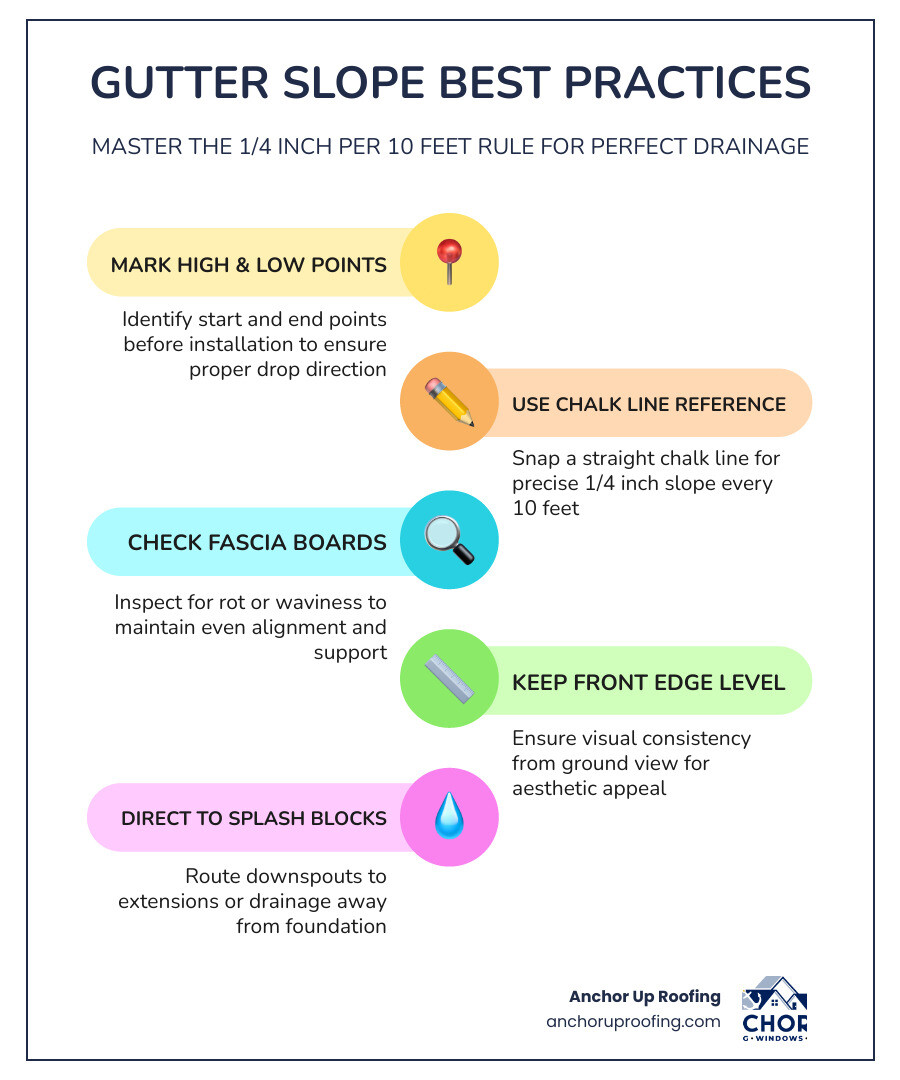
A few pitch best practices:
- Mark high and low points before hanging anything
- Use a chalk line for a straight reference
- Check fascia boards for rot or waviness first
- Keep the front edge visually consistent from the ground
- Make sure downspouts discharge onto splash blocks, extensions, or a drainage system that moves water away from the foundation
Improper slope causes standing water, mosquito-friendly puddles, premature corrosion, and sagging. Too much slope creates an obvious visual tilt. Perfect pitch is where function and curb appeal shake hands.
Step-by-Step Guide to DIY Gutter Setup
If you are tackling a basic DIY gutter project, careful planning matters more than confidence. Gutters look simple until you are 15 feet up a ladder holding a 10-foot section in the wind.
If you decide a professional install is the better fit, learn more about our Gutter Installation services.
Essential tools and materials usually include:
- extension ladder
- tape measure
- chalk line
- drill/driver
- screws or lag fasteners
- hacksaw or miter saw with proper blade
- hole saw for outlet cuts
- crimper
- rivet gun and pop rivets
- gutter sealant
- level
- tin snips
- work gloves
- eye protection
- gutter hangers or brackets
- end caps
- outlets, elbows, and downspouts
Basic DIY process:
Measure the roofline.
- Measure each fascia run.
- Add roughly 10% extra material for cuts and mistakes.
Inspect the fascia and drip edge.
- Replace rotten wood before installation.
- Confirm the gutter can sit just below the roof edge and under the drip line where appropriate.
Plan downspout locations.
- Use one downspout about every 20 to 40 feet.
- Add more in heavy-rain areas or where roof valleys dump water.
Mark the slope.
- Snap a chalk line showing a 1/4 inch drop per 10 feet toward the outlet.
Install hangers or brackets.
- Space them about every 18 to 24 inches.
- Fasten into solid backing, ideally rafter tails or sturdy fascia support.
Cut and assemble gutter sections.
- Attach end caps.
- Seal seams thoroughly.
- If using sectional gutters, overlap joints so water flows from the upper piece into the lower piece, not against the seam.
Cut outlet holes.
- Use a hole saw or snips depending on the system.
- Install outlets securely and seal around them.
Hang the gutters.
- Follow the chalk line.
- Check alignment frequently so the run does not look wavy or twisted.
Install downspouts.
- Connect elbows and vertical runs.
- Strap downspouts to the wall every 4 to 6 feet.
Test with a hose.
- Look for leaks, pooling, slow drainage, and overflow points.
Common Mistakes to Avoid During Residential Gutter Installation
Most gutter problems are not mysterious. They are installation mistakes wearing a disguise.
Avoid these common issues:
Incorrect pitch
- Too flat and water sits
- Too steep and the gutter looks off
Hangers spaced too far apart
- This causes sagging, especially in storm conditions
Poor sealing
- Small seam leaks become fascia rot over time
Backward overlaps
- Water should flow over overlaps, not into them
Too few downspouts
- Overflow is often a capacity problem, not a cleaning problem
Ignoring fascia damage
- Rotten wood cannot hold fasteners well
Bad ladder safety
- DIY gutter work is one of those tasks that feels easy right up until it really is not
Installing Downspouts and Outlets
Downspouts are where your system either succeeds or betrays you.
A good setup includes:
- properly sized outlets
- secure elbow connections
- straps every 4 to 6 feet
- discharge at least 4 feet from the foundation
- splash blocks, extensions, or tied-in drainage where needed
For larger 6-inch systems, 3×4-inch leaders are often preferred because they move water faster and clog less easily than smaller downspouts.
Also think beyond the wall. If your downspouts feed underground drains, those pipes need occasional flushing too. A clean gutter above does not help much if the buried pipe below is packed with sediment.
Why Professional Expertise Outperforms DIY
DIY can work on a low, simple roof with sectional materials. But most homeowners in South Florida are better served by professional installation, especially on two-story homes, complex rooflines, or houses exposed to severe weather.
Learn more about the full exterior solutions we provide on our Services page.
Professional installation brings clear benefits:
- accurate sizing based on roof area and rainfall intensity
- cleaner slope layout
- safer ladder and roof work
- stronger fastening methods
- seamless on-site fabrication
- better integration with soffit, fascia, and drainage systems
- faster completion
- warranty protection
The Benefits of On-Site Seamless Fabrication
This is one of the biggest reasons pros outperform DIY.
With on-site seamless fabrication, we can form long gutter runs to the exact dimensions of your home. That means:
- minimal seams
- better fit around roof geometry
- cleaner curb appeal
- fewer long-term leak points
- efficient installation
Hidden hangers also improve both performance and appearance. They support the system from inside the gutter instead of relying on older spike-and-ferrule styles that can loosen over time.
In South Florida, we also pay attention to heavier-gauge materials, solid fastening, and water management paths that can stand up to violent storm bursts. A gutter is only as good as the way it is attached and drained.
Safety and Warranty Considerations
This part is not glamorous, but it matters.
Professional installers help reduce the risk of:
- ladder falls
- cutting injuries
- incorrect fastener placement
- fascia damage
- drainage errors that show up after the next storm
Just as important, reputable contractors typically offer:
- workmanship warranties
- manufacturer-backed material warranties
- documented scope of work
- financing options in many cases
When you compare pro installation to DIY, remember to compare more than material cost. Also compare your time, safety risk, tool purchases, cleanup, and the cost of fixing mistakes later. A gutter that leaks behind the fascia can quietly create expensive damage before you notice a thing.
Frequently Asked Questions about Gutter Installation
How often should I clean my gutters if I don’t have guards?
At minimum, clean and inspect them twice a year, typically in spring and fall.
In South Florida, we also recommend checking them:
- before hurricane season
- after major storms
- more often if you have heavy tree cover
- anytime you notice overflow, staining, or plant growth in the gutter
Maintenance should include:
- removing leaves and debris
- flushing runs with water
- testing each downspout
- checking sealant and hangers
- confirming water discharges away from the home
If your house has lots of nearby trees, quarterly checks may be smarter than waiting for a clog to make the decision for you.
Are gutter guards worth the investment for South Florida homes?
Often, yes, but with a realistic expectation.
Gutter guards reduce the amount of debris entering the system, which can cut down on cleaning frequency. They are especially helpful if your home sits under trees or palms. Common options include:
- screens
- mesh guards
- surface-tension covers
- foam inserts
- heated systems in cold climates, though heater cables are generally not a South Florida need
That said, guards are not magic. They reduce maintenance, but they do not eliminate it. Fine debris, seed pods, and roof grit can still collect over time. We usually recommend guards when:
- the home has frequent clogging
- the gutters are hard to access
- the owner wants lower maintenance
- nearby trees drop leaves, flowers, or palm debris year-round
For South Florida homes, the best guard is one that still handles fast, high-volume rainfall without causing water to shoot over the gutter edge.
Conclusion
A well-designed gutter system protects much more than your roofline. It helps defend your foundation, siding, landscaping, soffits, fascia, and walkways from ongoing water damage. That is why residential gutter installation is not just a cosmetic upgrade. It is a drainage strategy.
For most South Florida homes, the winning formula is straightforward:
- seamless aluminum gutters
- the right size for your roof and rainfall
- 1/4 inch of slope per 10 feet
- enough downspouts to move water quickly
- regular maintenance or quality guards
At Anchor Up Roofing, we bring South Florida expertise to every installation, along with the reliability of a retired veteran-owned company, 20+ years of exterior experience, 5-star service, and 100% financing options for qualified homeowners.
If you want your gutters sized correctly, pitched correctly, and built for Florida weather, Schedule your professional residential gutter installation today.