

A Leaking Flat Roof Won’t Fix Itself — Here’s What to Do First
Flat roof repair is something most South Florida homeowners will face at least once — and the sooner you act, the cheaper the fix.
Quick answer: How to repair a leaking flat roof
- Find the leak source — trace it uphill from any interior water stain
- Dry the area completely — never patch a wet surface
- Clean and prep the membrane — remove debris, dirt, and loose material
- Apply the right patch for your roof type — EPDM, TPO, PVC, or Modified Bitumen each need specific products
- Overlap the patch by at least 4 inches on all sides of the damage
- Seal the edges and let the repair cure 24–72 hours before rain exposure
- Clear your drains — ponding water is often the root cause
Here’s the frustrating truth about flat roofs: a small damp spot on your ceiling that disappears by morning doesn’t mean the problem is gone. It means water is already moving through your roof system, and every rainstorm is making it worse.
Florida’s heat, UV exposure, heavy afternoon downpours, and hurricane-season wind stress make flat roofs work harder than almost anywhere else in the country. Ignore a minor blister or a slow seam failure, and you’re looking at saturated insulation, warped decking, and a repair bill that dwarfs what a quick fix would have cost.
I’m Oscar Perez, founder of Anchor Up Roofing and a South Florida roofing contractor with years of hands-on experience in flat roof repair across Miami-Dade, Broward, and beyond. This guide walks you through everything I’d tell a homeowner standing on their roof with a bucket of sealant and a problem they’re not sure how to solve.

Find the Leak Before You Patch Anything
The biggest mistake in flat roof repair is fixing the symptom instead of the source. A stain on the ceiling is a clue, not a map.
Start inside. Measure the stain from two fixed points, like the nearest walls. Then transfer those measurements to the roof. From there, inspect uphill from that area, because water often travels along joists, insulation layers, and decking before it finally shows up indoors.
Look closely at:
- Seams and lap joints
- Roof drains and scuppers
- Pipe boots and penetrations
- Parapet walls and edge flashing
- Low spots with standing water
- Cracks, punctures, and pulled membrane edges
If the source is still unclear, a controlled hose test can help. One person sprays small sections of the roof at a time while another watches inside. Go slowly. Flooding the whole roof at once only creates confusion.
For stubborn leaks or larger buildings, a professional moisture survey can uncover trapped water beneath the membrane before it turns into rot.
Why ceiling stains rarely line up with the roof breach
Flat roofs are low-slope, not perfectly flat. Water still moves. It can run sideways along the underside of the membrane, track along framing, or soak insulation and reappear several feet away from the actual opening.
That is why the leak is usually:
- Upslope from the interior stain
- Near a seam or penetration
- In a ponding area that holds water more than 48 hours after rain
If you patch directly above the stain without tracing the route, you may only give the leak a new hiding place. Sneaky, right?
The most common causes of flat roof leaks and damage
In South Florida, we most often see leaks caused by a mix of weather, drainage issues, and material aging.
Common culprits include:
- Ponding water from poor slope or clogged drains
- Debris buildup that blocks drainage
- Punctures from foot traffic or dropped tools
- UV damage that dries out or weakens membranes
- Seam failure on single-ply roofs
- Flashing failure around walls, vents, and curbs
- Blistering from trapped air or moisture
- Shrinkage, especially on aging modified bitumen systems
- Poor installation or bad product compatibility
- Storm stress from wind-driven rain
Red flags that point to saturated insulation or structural damage
Sometimes a leak is no longer just a leak. It is a roof system problem.
Watch for these warning signs:
- Soft or spongy areas underfoot
- Bubbling drywall or peeling interior paint
- Persistent mold or musty odors
- Warped decking
- Repeated leaks in the same spot
- Sagging roof areas
- Wet insulation exposed during repair
- Cracks around parapets or roof edges
If you find any of those, stop thinking “weekend patch” and start thinking “professional inspection.” Wet insulation loses energy performance, and structural movement can keep tearing open the same repair.
Flat Roof Repair Starts With the Right Roof Type
Not all flat roofs are repaired the same way. In fact, using the wrong product is one of the fastest ways to turn a small leak into a larger one.
The main flat roof types we see in South Florida are EPDM, TPO, PVC, Modified Bitumen, and sometimes BUR. Each has its own repair method, adhesive requirements, and compatibility rules. If you are not sure what you have, check installation paperwork or have us confirm it before you patch.
| Roof type | What it looks like | Typical repair method | Common warning |
|---|---|---|---|
| EPDM | Black rubber membrane | Primer plus self-adhered patch | Asphalt products can cause failure |
| TPO | Usually white single-ply | Heat-welded patch or approved system patch | Wrong sealant may not bond |
| PVC | White or gray single-ply | Heat-welded repair, compatible cleaner | Chemical incompatibility matters |
| Modified Bitumen | Granulated or smooth rolled membrane | Asphalt-based cement, membrane patch | Shrinkage and split laps are common |
Flat roof repair on EPDM, TPO, PVC, and Modified Bitumen
EPDM repairs usually rely on cleaning the surface, applying EPDM primer, and installing a compatible patch. No torching needed.
TPO and PVC are different. These single-ply membranes are usually best repaired with heat-welded patches or manufacturer-approved systems. If the membrane is contaminated or overheated, the patch may fail.
Modified Bitumen often uses roofing cement, reinforcing fabric, and a matching membrane patch. On larger repairs, the damaged section may need to be cut back to sound material before patching.
BUR systems can sometimes be patched, but they are less DIY-friendly because gravel surfacing and multiple layers make leak tracing harder.
Which repair materials should never be mixed
A good rule: match the repair product to the roof membrane.
Never assume “roof sealant” is universal. It is not.
Avoid these bad combinations:
- Asphalt cement on TPO or PVC
- Random solvent-based products on single-ply membranes
- Silicone or generic caulks where a membrane-specific sealant is required
- Torch methods on systems not designed for heat
- Mixing patch materials from another roof type just because they were on sale
The risks include:
- Failed adhesion
- Chemical damage to the membrane
- Short-lived repairs
- Voided manufacturer warranty
When a quick sealant fix is temporary versus acceptable
A quick sealant fix can be acceptable when:
- You are stopping active water entry before a storm
- The damage is tiny and isolated
- You are buying time for a proper repair within days
It is temporary when:
- The leak has returned before
- The membrane is cracked, blistered, or pulling apart
- Water is ponding in the same area
- The substrate underneath is wet
- The roof is near the end of its service life
Think of emergency sealant as a raincoat, not a rebuild.
How to Do a Lasting Flat Roof Repair Step by Step
If the damage is minor and the deck is sound, a careful DIY repair may hold up well. The key word is careful.
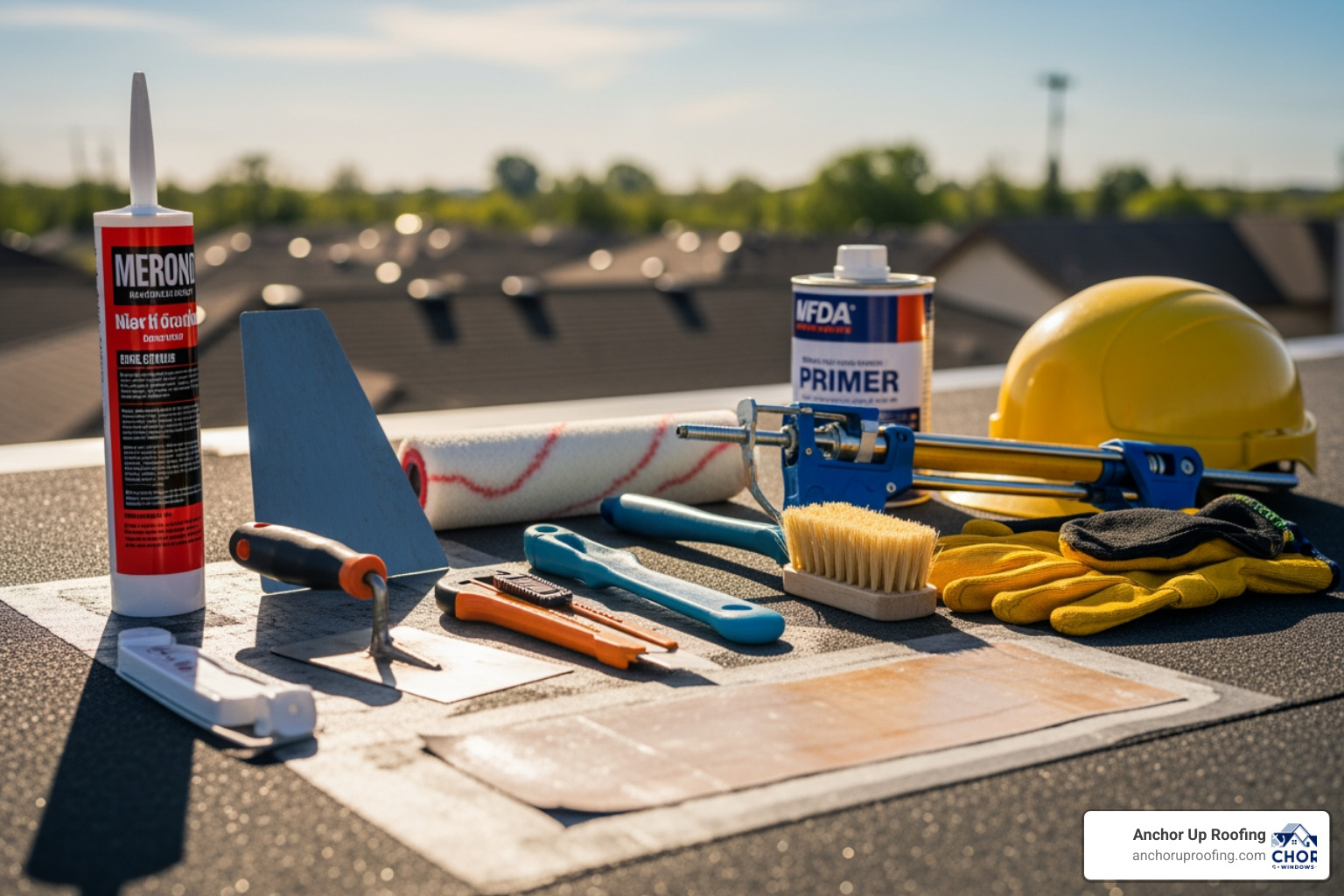
Surface preparation that makes or breaks adhesion
Most failed patches fail because of prep, not because the patch was too small.
Before any patch goes down:
- Pick a dry day with no rain in the forecast.
- Sweep away dirt, gravel, and loose debris.
- Remove any loose or deteriorated roofing material.
- Dry the area completely. Towels, airflow, and patience help.
- Clean the membrane with the manufacturer-approved cleaner if required.
- Roughen smooth surfaces only if the repair system calls for it.
- Apply primer where the roof type requires it.
- Let primer flash off or dry as directed.
Research-based best practices consistently show that patch areas should extend beyond the visible damage. A safe rule is at least 4 inches, and many pros go 75 to 100 mm or more depending on the product.
Step-by-step flat roof repair for punctures, cracks, and open seams
For a basic localized repair:
- Mark the damaged area.
- Cut away only loose or unsound material.
- Make sure the substrate underneath is solid and dry.
- Cut your patch so it overlaps the damage by at least 4 inches on all sides.
- Apply primer or adhesive specified for your roof type.
- Set the patch in place and press firmly.
- Use a hand roller to remove bubbles and fully seat the patch.
- Seal edges if the repair system requires edge treatment.
- Let it cure fully before rain exposure or foot traffic.
For modified bitumen, repairs often include reinforcing fabric embedded in roofing cement, with edges feathered beyond the damaged area. Some guides recommend cement around 1/8 inch thick and a second layer after initial cure when the system calls for it.
How to fix ponding water, blistering, and failed flashing
Some issues are not just “patch here and move on.”
Ponding water
Standing water that remains more than 48 hours after rain is a problem. Start simple:
- Clear clogged drains and scuppers
- Remove debris
- Check strainers and outlets
- Confirm gutters are flowing
If water still ponds, the issue may be slope loss, deck deflection, or compression in insulation. That usually calls for tapered insulation, added drainage, or partial reroof work.
Blistering
Small blisters can be cosmetic. Large blisters or blisters in traffic paths are not.
If a blister is cracked, wet, or likely to rupture:
- Cut back to sound material only if the system and your skill level allow it
- Let trapped moisture dry completely
- Patch with compatible materials
If the blister is widespread, do not chase every bubble with a knife. That is a sign the roof is aging or moisture is trapped below the membrane.
Failed flashing
Flashing is one of the most common leak points. Check around:
- Vents
- Curbs
- Skylights
- Wall transitions
- Parapet caps
Loose flashing may need to be resecured and resealed. Split or deteriorated flashing should usually be replaced, not smeared over.
DIY safety gear and precautions for roof work
Yes, flat roofs are easier to stand on than steep roofs. No, they are not safe by default.
Use:
- A stable ladder on firm ground
- Non-slip rubber-soled shoes
- Work gloves
- Eye protection
- A fall protection harness when needed
- Knee pads if you will be down on the membrane
- Sun protection and plenty of water
Also follow these rules:
- Never work on a wet roof
- Never work alone
- Avoid repairs in extreme heat
- Watch for weak decking around leak areas
- Keep tools organized so you do not puncture the roof yourself
South Florida heat can be as dangerous as the roof edge. If the roof is blazing by noon, call it and finish early another day.
Repair, Restore, or Replace? How to Make the Smart Money Decision
Not every leaking roof needs replacement. But not every leaking roof deserves another patch either.
A smart decision weighs:
- Age of the roof
- Frequency of leaks
- Extent of wet insulation
- Amount of surface damage
- Warranty status
- Cost of repeated service calls
You can learn more about system options on our Flat Roofs page and how coatings fit into the picture on our Roof Coating and Waterproofing guide.
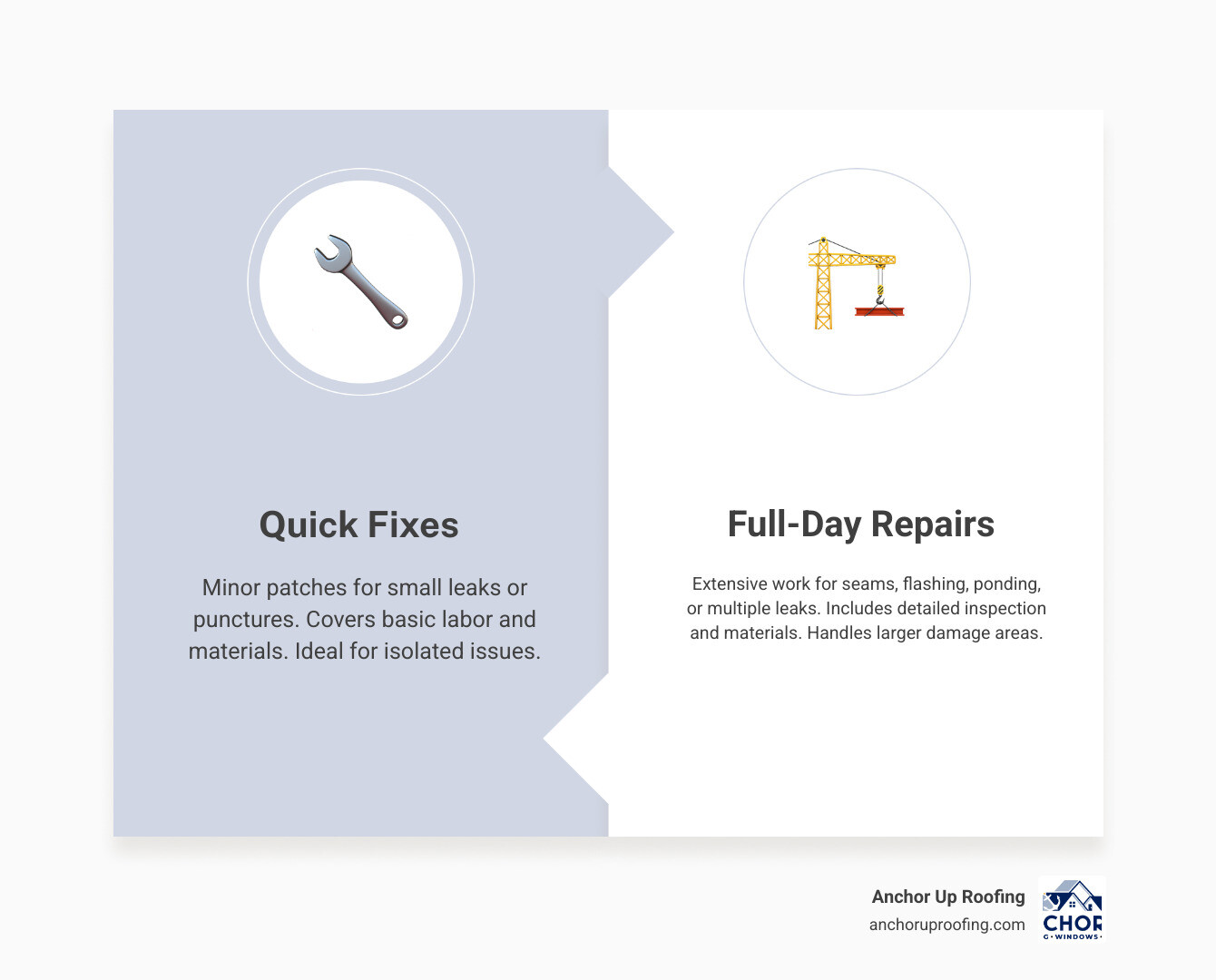
When restoration or coating is more cost-effective than replacement
If the roof is aging but still fundamentally sound, restoration can be the sweet spot.
A reflective or elastomeric coating can:
- Seal minor surface wear
- Improve UV resistance
- Reflect heat
- Slow membrane aging
- Extend service life by 10 to 15 years in suitable cases
That is especially useful in South Florida, where UV exposure is relentless. Coatings are not magic, though. They work best when the roof is dry, stable, and repaired first. Coating over wet insulation or bad seams is like painting over a plumbing leak.
When full replacement is the better call
Replacement is usually the better investment when:
- More than about 25% of the roof is damaged
- Insulation is saturated across large areas
- The deck is soft or structurally compromised
- Leaks keep returning despite repairs
- The roof is at the end of its service life
- You need a new warranty path
A full replacement often comes with warranties exceeding 20 years when the roof is properly maintained. If you are repeatedly paying to patch the same problem area, replacement may actually be the cheaper choice over time.
Maintenance That Prevents Your Next Leak
The best flat roof repair is the one you never have to make.
Regular maintenance matters because flat roofs drain slowly by design. Small drainage issues become big leak issues fast in our climate.
Seasonal flat roof repair prevention checklist
At minimum, inspect your flat roof twice a year, usually in spring and fall, plus after major storms.
Your checklist should include:
- Clear leaves, dirt, and debris
- Check drains, scuppers, and gutters
- Look for standing water after rain
- Inspect seams and lap edges
- Review flashing around all penetrations
- Check for punctures from service traffic
- Look for blisters, cracks, and shrinkage
- Inspect interior ceilings for new stains
- Photograph changes so you can compare over time
If your roof supports HVAC equipment, consider walkway pads to reduce foot-traffic damage.
For homeowners, our guide on when to schedule a residential roofing inspection is a good next read.
How coatings and regular inspections extend roof life
Inspections catch problems while they are still cheap. Coatings help protect aging roofs from UV, minor weathering, and thermal movement.
Together, they can:
- Reduce crack formation
- Improve waterproofing
- Reflect sunlight and lower heat load
- Delay major capital replacement
- Help preserve the membrane longer
If you manage a larger property, our commercial roof inspection checklist outlines what to review. For an additional outside perspective, industry resources from the National Roofing Contractors Association highlight the importance of early maintenance and matching the repair method to the membrane.
Frequently Asked Questions About Flat Roof Repair
How long does a flat roof repair usually last?
It depends on the roof type, the quality of the prep, the compatibility of materials, and ongoing maintenance. A well-done repair on a sound roof can last for years. A rushed patch on a wet, dirty, or failing membrane may not last through the next rainy stretch.
Coatings can help extend repair life by adding UV and weather protection.
Can I repair a flat roof myself or should I call a pro?
DIY is reasonable for:
- Small punctures
- Minor open seams
- Isolated edge resealing
- Emergency temporary waterproofing
Call a pro for:
- Ponding water that keeps returning
- Soft decking or wet insulation
- Large blisters
- Repeated leaks in the same area
- Heat-welded TPO or PVC repairs
- Storm damage
- Any roof still under warranty
If you are not sure whether you need repair or replacement, professional diagnosis is cheaper than guessing wrong.
How often should a flat roof be inspected?
Twice yearly is the minimum. Also inspect after hurricanes, tropical storms, heavy wind events, or any time rooftop equipment has been serviced.
Older roofs and roofs with frequent foot traffic should be checked more often.
Conclusion
A successful flat roof repair comes down to three things: finding the real leak source, using materials that match the roof you have, and being honest about when a patch is no longer enough.
For a weekend warrior, small repairs can absolutely be manageable. But if you see soft spots, widespread ponding, recurring leaks, or signs of structural moisture, it is time to step back and bring in help.
At Anchor Up Roofing, we help homeowners and property managers across South Florida, including Venice, Miami-Dade, Broward, Naples, Fort Myers, Homestead, and surrounding areas, make smart repair decisions before small leaks turn into expensive rebuilds.
Learn more about our Services or Contact us to schedule an inspection.