

What You Need to Know About Getting a Miami-Dade Roofing Permit
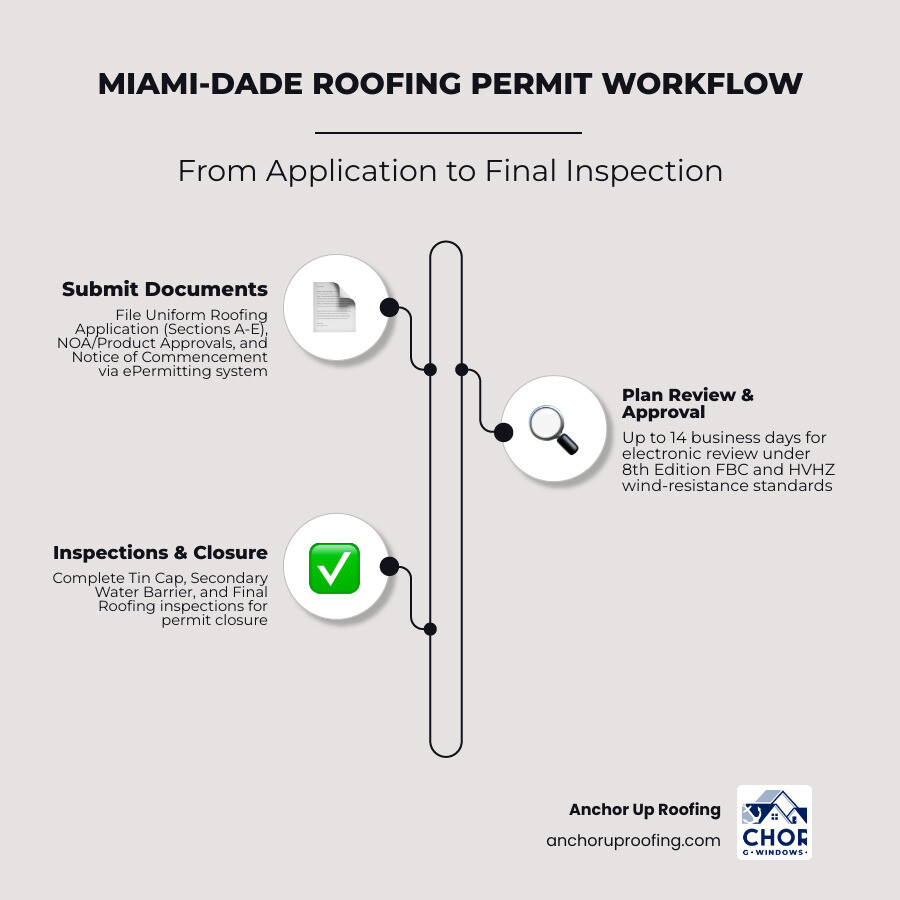
Getting a miami-dade roofing permit is required for any roofing work — repairs, replacements, or new installations — on both residential and commercial properties. Here’s what that process looks like at a glance:
Quick Answer: Miami-Dade Roofing Permit Essentials
| Step | What You Need |
|---|---|
| 1. Determine permit type | Residential re-roof, new roof, or commercial |
| 2. Gather documents | Uniform Roofing Application (Sections A–E), NOA or Florida Product Approval, Notice of Commencement |
| 3. Submit application | Via Miami-Dade ePermitting system (contractors) or in person |
| 4. Plan review | Up to 14 business days for first review cycle |
| 5. Inspections | Tin Cap, Base Application, Secondary Water Barrier, Final Roofing |
| 6. Final approval | Permit closed after passing all required inspections |
Miami-Dade sits entirely inside Florida’s High Velocity Hurricane Zone (HVHZ) — the strictest roofing jurisdiction in the country. That means every roofing project must comply with the 8th Edition Florida Building Code and specific HVHZ wind-resistance standards. All materials must carry a Miami-Dade Notice of Acceptance (NOA) or Florida Product Approval. Skipping the permit isn’t just risky — it can result in fines, forced removal of completed work, and serious complications when selling your home.
The process can feel overwhelming, especially if it’s your first time dealing with it. But once you understand the steps, it becomes much more manageable.
I’m Oscar Perez, founder of Anchor Up Roofing, and I’ve guided countless South Florida homeowners through the miami-dade roofing permit process across projects in Miami, Hialeah, Homestead, and beyond. In this guide, I’ll break down exactly what you need — forms, inspections, system-specific requirements, and more — so you can move forward with confidence.
Understanding Miami-Dade Roofing Permit Requirements
In May 2026, we are operating under the 8th Edition Florida Building Code (FBC). This is the “rulebook” for all construction in our state, and for those of us in South Florida, it includes the very specific High Velocity Hurricane Zone (HVHZ) protocols. These are the most stringent wind-resistance standards in the United States, designed to ensure your roof stays attached when the wind starts howling at 170+ mph.
A common question we hear is: “Do I really need a permit for a small repair?” In Miami-Dade, the answer is almost always yes. Any roof replacement, full tear-off, or re-cover requires a permit. Even partial repairs that exceed a certain percentage of the roof area (typically 25%) will trigger the need for a full permit and total compliance with current HVHZ standards.
If you aren’t sure if your roof is ready for work, you should look for Signs Your Roofs Need a Replacement. Ignoring these signs only makes the eventual permitting and construction process more difficult. When you are ready to start, the foundation of your project is the Hurricane Roof Application. This document ensures that every component of your new roof—from the nails to the shingles—is rated for our unique climate.
Essential Documentation for Your Miami-Dade Roofing Permit
Paperwork is the hurdle that stops most DIY-inclined homeowners in their tracks. To get a miami-dade roofing permit, you can’t just hand over a napkin sketch. The county requires a comprehensive package of technical documents.

The Uniform Roofing Application
The star of the show is the Uniform Roofing Application. This form is divided into sections A through E:
- Section A: General information about the property and the contractor.
- Section B: The Roof Plan, showing dimensions, pitch, and drainage.
- Section C: Specifics for Low-Slope (flat) roof systems.
- Section D: Specifics for Steep-Slope systems (shingles, tile, metal).
- Section E: Detailed tile calculations for those choosing a Mediterranean look.
Notice of Commencement (NOC)
For projects exceeding a certain valuation threshold, a Notice of Commencement must be recorded with the Clerk of the Courts. This document protects the property owner by identifying the source of funds and the parties involved. You’ll need a certified copy of this to even get your first inspection.
Product Approvals (NOA)
Every material used must have a Miami-Dade Notice of Acceptance (NOA) or a Florida Product Approval number. This proves the material has been lab-tested to survive hurricane-force winds. Without these numbers, your application will be rejected immediately.
Choosing the right partner is vital here. We always recommend reading How to Choose the Right Roofing Contractor: 5 Questions to Ask to ensure your pro knows how to handle these technical filings. If you’re tackling a flat roof, specifically, keep the Residential Permit, Re-roofing, Flat Roof, Applicant Checklist_Remediated handy to ensure nothing is missed.
Navigating the E-Permitting System and Owner-Builder Options
Gone are the days when you had to stand in line at the Permitting and Inspection Center (though that’s still an option). Today, most of the magic happens online.
Applying for a Miami-Dade Roofing Permit Online
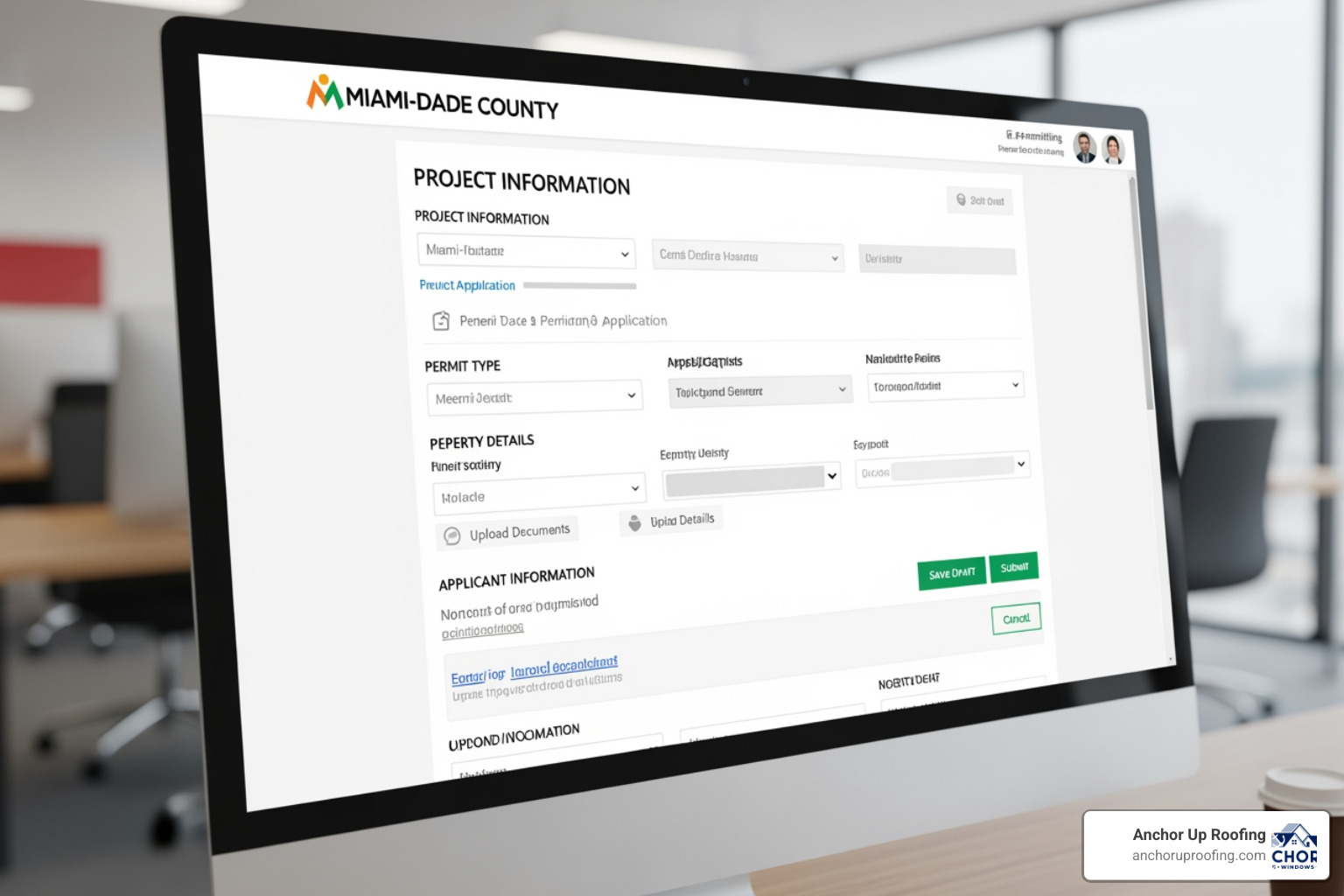
Qualified contractors use the E-Permitting system to submit applications. Once a contractor starts the process, the system generates a unique “W” process number. This number is your golden ticket—it allows you to track the status of the plan review, pay fees, and schedule inspections.
If you or your contractor hit a snag, Miami-Dade offers MeetQ consultations. This allows you to schedule a digital meeting with a plan reviewer or inspector to clear up any confusion without driving to the office. Digital signatures and seals are now the standard for all uploaded plans, making the process much faster than the old paper-and-ink days. You can find the full rules in the Guidelines for the Roofing E-Permitting System.
Owner-Builder Limitations for a Miami-Dade Roofing Permit
Can you pull the permit yourself? Yes, but with major caveats. Florida law allows an “Owner-Builder” to pull a permit for their own primary residence, provided they don’t intend to sell the home within one year of completion.
However, Miami-Dade doesn’t make it easy. You must sign a sworn Owner-Builder Disclosure Affidavit. For certain roof types, you may even be required to pass an exam or an interview with a building official to prove you actually know how to install a roof to HVHZ standards. Generally, owner-builders are limited to shingle roofs; complex systems like tile or hot-mop flat roofs almost always require a licensed professional.
Mandatory Inspections and Hurricane Mitigation Standards
Getting the permit is only half the battle. To “close” the permit and ensure your roof is legal, you must pass a series of inspections. These happen at critical milestones when the inspector can still see the “guts” of the roof.
| Inspection Type | What They Are Looking For |
|---|---|
| Tin Cap / Sheathing | Proper nail spacing on the wood deck and underlayment attachment. |
| Secondary Water Barrier | Verification that the “backup” waterproof layer is sealed correctly. |
| Mop-In-Progress | (For flat roofs) Ensuring asphalt is at the right temperature and coverage. |
| Tile Uplift Test | A physical test (often by an engineer) to ensure tiles won’t fly off. |
| Final Roofing | Checking flashing, vents, and overall aesthetic/code compliance. |
The “Tin Cap” inspection is arguably the most important. If you cover your underlayment before the inspector sees the nail pattern, they can—and will—make you tear it all off so they can see it. This is why knowing When to Schedule a Residential Roofing Inspection is the difference between a smooth project and a costly nightmare.
Specific Requirements for Different Roof Systems
Not all roofs are created equal in the eyes of Miami-Dade building officials.
- Low-Slope Systems: These are roofs with a pitch of 2/12 or less. They require specific drainage calculations and often involve multi-layer “built-up” systems or single-ply membranes like TPO.
- Tile Roofs: These are heavy. The county requires RAS 127 tile calculations to prove the roof structure can handle the weight and that the attachment method (nails, foam, or mortar) can withstand wind uplift.
- Metal Panels: These require specific “lap” seals and fastener spacing that must match the NOA exactly.
- SPF (Spray Polyurethane Foam): A great option for insulation, but it requires a “Special Inspector” to be present during the application.
Also, keep in mind that if you live in a community with a Homeowners Association, the New Florida HOA Law 2024 has changed how much power your HOA has over your roofing choices, particularly regarding hurricane-resistant materials.
Frequently Asked Questions about Miami-Dade Roofing Permits
How long does the permit review process typically take in 2026?
In 2026, the standard review cycle for a residential miami-dade roofing permit is about 10 to 14 business days. However, if you are in a municipality like the City of Miami or Miami Gardens, or if your project requires structural remediation (like replacing rotted wood nailers), it can take 3 to 6 weeks.
Do partial roof repairs require a full building permit?
Yes, in most cases. If the repair is more than a simple patch, or if it involves more than 25% of the total roof area, the Florida Building Code requires a permit and often mandates that the entire roof be brought up to current HVHZ standards.
What is a Miami-Dade Notice of Acceptance (NOA) and why is it required?
An NOA is a document issued by the Miami-Dade Product Control Section. It’s essentially a certification that a product has passed rigorous testing for wind resistance, water infiltration, and impact. It is required because standard “Florida Product Approvals” aren’t always tough enough for the High Velocity Hurricane Zone.
Conclusion
Navigating the miami-dade roofing permit process doesn’t have to be a headache. Whether you’re in Doral, Hialeah, or Miramar, the key is preparation. By gathering your NOAs, recording your Notice of Commencement, and following the e-permitting guidelines, you can ensure your home is protected by a roof that meets the highest safety standards in the world.
At Anchor Up Roofing, we take the stress out of the paperwork. As a retired veteran-owned business with over 20 years of experience, we handle the entire permitting and inspection process for you. We offer comprehensive financing options to help you get the protection you need without the upfront financial burden.
Ready to secure your home? Learn How to Finance Your Roof Replacement or explore our Professional Roofing Services today. We’re here to help you anchor up and weather any storm.