

Why Shingling a Hip Roof Is More Demanding Than a Standard Gable Roof
Shingling a hip roof correctly takes more skill, planning, and precision than a basic gable roof – and getting it wrong in South Florida’s storm climate can be costly.
Here’s a quick overview of what the process involves:
- Prepare the deck – Install drip edge, underlayment, and ice-and-water shield
- Lay field shingles – Work each course around all four slopes, trimming at every hip line
- Cut shingles at the hip ridge – Trim field shingles back about 3/4 inch from the hip centerline before capping
- Install hip cap shingles – Start at the bottom (eave) and work upward, overlapping each cap
- Terminate and seal – Finish caps at the main ridge junction with custom cuts and roofing cement
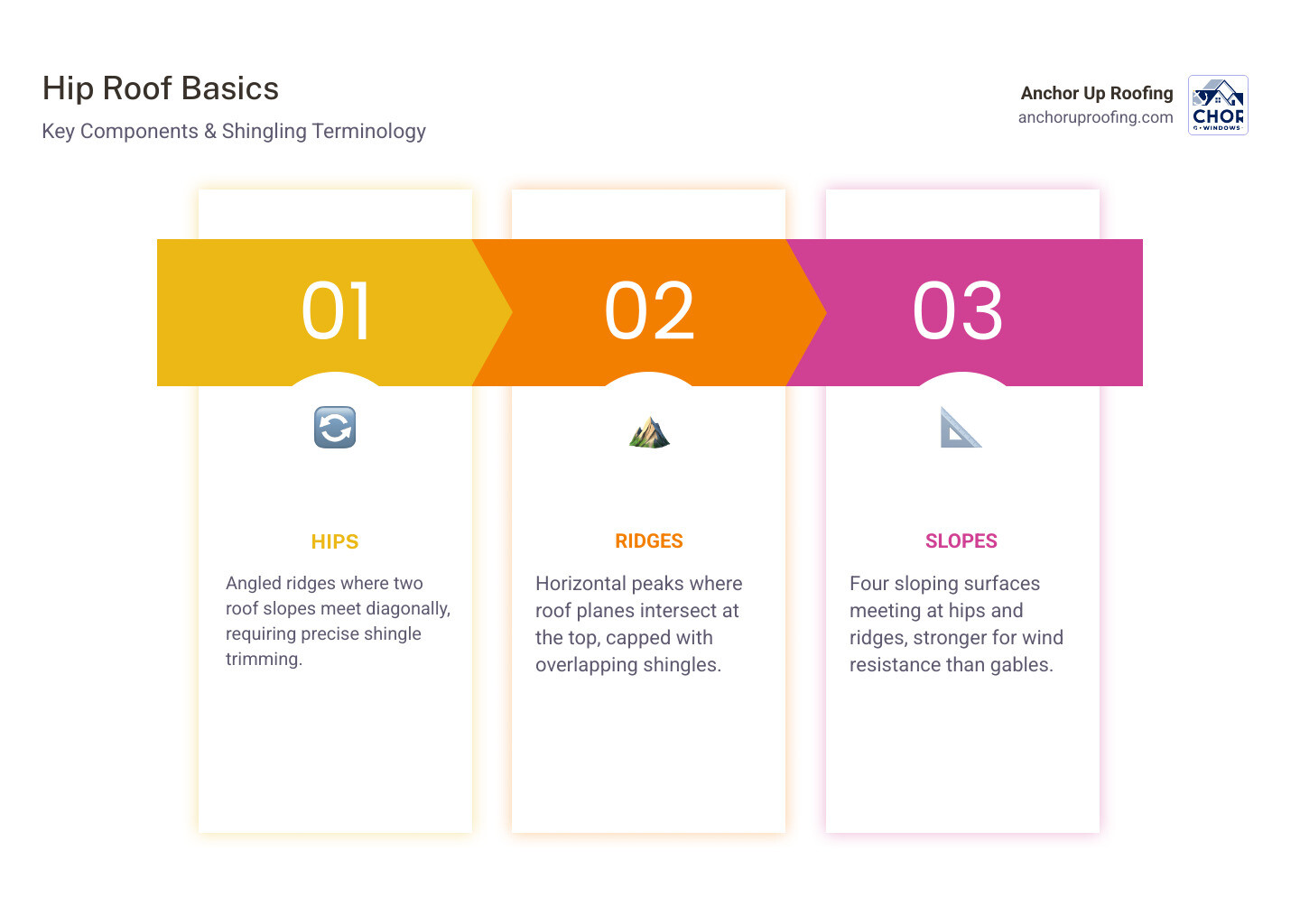
A hip roof has four sloping sides that all meet at angled ridges called hips. Unlike a gable roof – which has just two slopes and two flat end walls – every corner of a hip roof is a diagonal junction that requires precise shingle cuts and carefully planned courses. That geometry makes it harder to shingle, but it also makes the roof stronger and better at shedding water and wind.
The extra complexity is exactly why so many homeowners and even some contractors get the details wrong – from misaligned courses to improperly finished ridge caps that invite leaks right at the worst possible spots.
I’m Oscar Perez, founder of Anchor Up Roofing, and I’ve spent years shingling a hip roof across South Florida’s demanding climate, from Miami-Dade to Fort Myers, helping homeowners get installations that hold up through hurricane season. In this guide, I’ll walk you through every step the way a seasoned pro would.
Preparation and Underlayment for a Hip Roof
Before a single shingle goes on, the roof deck needs to be dry, flat, secure, and code-ready. On hip roofs, prep matters even more because there are more angled transitions, more cut points, and more spots where wind-driven rain can test the system.
Start with the basics:
- Replace any soft, delaminated, or rotten decking
- Renail loose sheathing
- Verify fascia and drip-edge backing are sound
- Confirm ventilation layout before covering the deck
If your roof is older or showing wear, review the signs first in Signs Your Roof Needs a Replacement and schedule timing wisely using When to Schedule a Residential Roofing Inspection.
For underlayment, we generally recommend:
- Drip edge at eaves and rakes
- Synthetic underlayment for better tear resistance and walkability
- Self-adhered membrane at vulnerable areas where required by code or manufacturer
- Proper overlap and fastening so water always sheds downhill
On a hip roof, run the underlayment cleanly over the planes and lap it neatly at hips and ridges. The goal is simple: even if wind pushes water under the shingles, the underlayment still directs it out.
A few key points for South Florida conditions:
- High-wind fastening schedules matter
- Corrosion-resistant nails are a must
- Overdriven and underdriven nails both create problems
- Perimeter starter strips still belong on a hip roof; underlayment does not replace them
That last point trips people up. A peel-and-stick membrane is not a substitute for starter shingles. Starter strips are there to seal the first course and create the correct edge support.
If you want a good reference for ridge and hip concepts from a building-details perspective, see Wood Shingle or Shake Roof Hip / Ridge Installation. It is focused on wood roofing, but the geometry lessons still help.
Step-by-Step Process for Shingling a Hip Roof
Once prep is complete, the real work begins: laying field shingles so the courses stay straight as they run into diagonal hip lines.
The biggest difference from a gable roof is that you are not just running straight courses to a simple ridge. You are constantly approaching angled intersections, which means more layout work and more cutting.
Our basic process looks like this:
- Install starter along all eaves
- Snap control lines so exposures stay consistent
- Begin field shingles from the lower edge of each plane
- Maintain the manufacturer’s stagger pattern
- Work each course toward the hip, then trim cleanly
- Repeat on adjacent planes so courses visually track well
- Cap the hips after the field shingles are complete
Use chalk lines often. They are not optional on a hip roof unless you enjoy discovering drift halfway up the roof. And trust us, that is not the fun kind of surprise.
Field shingle fastening should follow the exact manufacturer instructions for the product being installed. In general, that means:
- Corrosion-resistant roofing nails
- Minimum deck penetration as required
- Usually 4 nails per shingle in standard applications
- Often 6 nails in high-wind zones or where required by code or manufacturer
Architectural shingles are the most common choice on South Florida homes because they are thicker, more dimensional, and generally stronger in wind than older 3-tab products.
| Shingle type | Best use | Pros | Tradeoffs |
|---|---|---|---|
| Architectural | Most residential hip roofs | Better appearance, thicker build, stronger wind performance | Higher cost, more weight |
| Three-tab | Budget-conscious or matching older roofs | Lower upfront cost, lighter, simpler cuts | Flatter appearance, usually lower wind resistance |
For a broader look at roofing materials, see Types of Residential Roofing Compared.
Cutting and Nailing Field Shingles at the Hip Ridge
This is one of the most misunderstood parts of shingling a hip roof.
Yes, it is common and acceptable to stop the field shingles short of the hip centerline before installing the cap. A cutback of about 3/4 inch from the hip line is a practical target on many asphalt shingle jobs, though we always defer to the shingle manufacturer’s instructions if they specify something different.
Why leave a gap?
- It prevents bulky buildup directly under the cap
- It helps the cap sit flatter and straighter
- It avoids forcing thick laminated shingles awkwardly over the hip
- It makes the finished line cleaner
That temporary strip of exposed underlayment is not a defect if it will be fully covered by the hip cap system. What would be a defect is leaving raw sheathing exposed to weather or cutting so far back that the cap cannot fully protect the area.
Best practice:
- Snap a centerline on the hip
- Trim each side consistently back from that line
- Keep the cut neat and straight
- Make sure underlayment remains intact beneath the cut zone
A hook knife blade is one of the best tools for this. It slices asphalt shingles from the back side with more control, especially on laminated shingles. Straight blades work, but hook blades usually make cleaner, safer cuts when following a long angle.
What about face nailing the edge near the hip?
Used carefully, limited face nailing near the trimmed edge can be acceptable when needed to keep cut field shingles flat until the cap covers them. The key is placement and purpose. It should not be random exposed nailing out in the water field. It should be:
- Near the hip area that will be fully covered by the cap
- High enough to remain protected by the overlap
- Done sparingly
- Sealed if required by manufacturer or high-wind detail
If someone face nails too low or outside the covered zone, that creates a leak risk. So the answer is not “face nailing is always bad” or “face nailing is always fine.” It is only safe when it remains inside the protected cap area and is done as part of a controlled finishing detail.
Also, do not simply bend thick architectural field shingles over the hip and hope they behave. Sometimes they will. Sometimes they fight back like a folding lawn chair with opinions.
Maintaining Alignment When Shingling a Hip Roof
Straight courses make a hip roof look sharp, but they also help the cap lay correctly.
On standard hip roofs, keep exposures consistent from plane to plane. The shingles on adjacent sides do not always need to line up perfectly tab-for-tab cosmetically, especially where different roof sections meet, but the exposure should remain correct. In other words:
- Functional alignment matters most
- Visual alignment matters where it is visible
- Exposure consistency always matters
On irregular roofs, gambrel sections, and shed roof tie-ins, this gets trickier. The old-school principle still applies: keep the courses true to the roof plane, not just visually lined up from a distance. Where pitch changes occur, plan ahead so transitions fall in less noticeable locations when possible.
Helpful layout habits:
- Snap horizontal guide lines frequently
- Measure exposure every few courses
- Dry-lay key courses before cutting into a complex hip
- Check how courses will die into adjacent sections before committing
If a shed roof intersects near a hip roof section, the shingles do not have to align perfectly for decoration alone. What matters is proper exposure, flashing, and water flow. Cosmetic matching is nice. Watertight roofing is nicer.
Installing Hip and Ridge Cap Shingles
After the field shingles are cut and secured, install the hip caps.
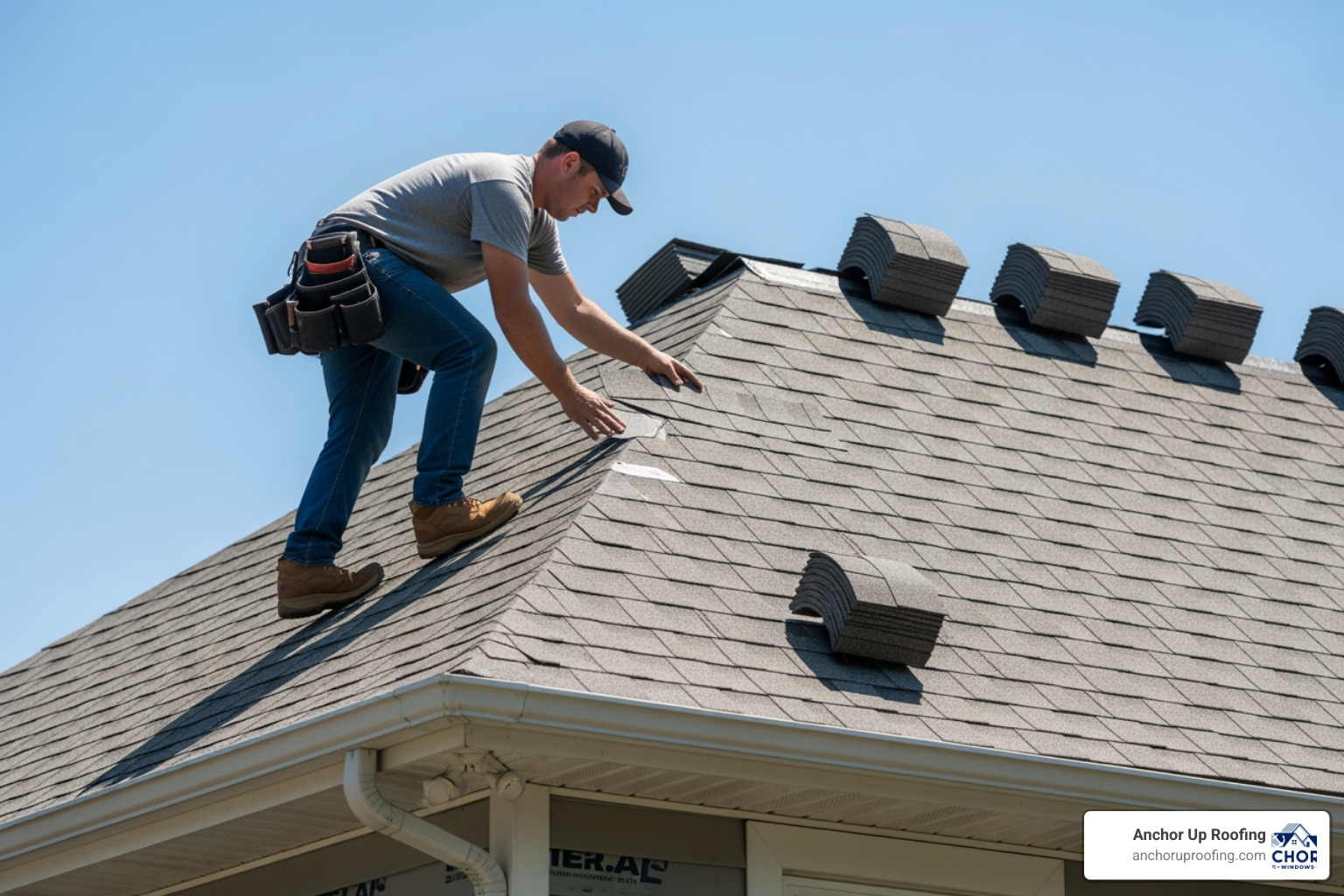
The proper method is bottom-up. Start at the eave end of the hip and work upward toward the ridge. This creates the correct weather lap so water sheds over each overlapping cap instead of being driven against the lap.
Pre-cut hip and ridge shingles are usually the cleanest option, and many manufacturers provide dedicated products for this purpose. If you are using a branded cap system, follow that product’s instructions exactly. For general technique guidance, How To Install Hip and Ridge Cap Shingles is a useful reference.
Here is the basic sequence:
- Snap a straight reference line on both sides of the hip if needed
- Cut or select the first starter cap for the lower end
- Set the first cap so it does not overhang the drip edge awkwardly
- Nail it according to exposure and nail zone requirements
- Continue upward, overlapping each cap evenly
- Keep both edges visually parallel to the hip line
The first cap at the bottom often needs special trimming. If you install a full cap there, it may stick past the eave or drip edge and look sloppy. The fix is simple: shorten the first cap so the visible portion finishes neatly at the lower edge without hanging too far past it.
That trimmed first piece acts like a starter for the hip cap run.
A few best practices:
- Keep cap exposure uniform all the way up
- Snap lines if the hip is long or highly visible
- Avoid weaving side to side as you install
- Press each cap flat before nailing so it seats properly
Some installers use caps cut from matching shingles; others use factory-made ridge caps for a more uniform look. Both methods can work if approved for the shingle system. Factory caps generally give a cleaner, more consistent finish on architectural roofs.
Nailing and Terminating Shingling a Hip Roof Caps
Most hip cap shingles are fastened with one nail on each side of the cap, placed above the exposed portion so the next cap covers the fasteners. A common rule of thumb is to place nails about 1 inch in from each edge, but exact placement depends on the cap product and manufacturer instructions.
So the general idea is:
- One nail per side
- Symmetrical placement
- High enough to be covered by the next cap
- Not so high that the cap is loose at the lower edge
In high-wind South Florida conditions, precision matters. Crooked nailing, overdriven fasteners, and missed deck penetration can all compromise performance.
Termination at the top of the hip takes more finesse than the middle run.
A common finishing approach is:
- Install caps normally until the last exposed piece
- Cut the final visible cap to length
- Use roofing cement under the finishing piece where required
- Face nail only where necessary and where the nail can be sealed and hidden with matching granules or covered by adjoining ridge work
Some roofers use a flip-and-finish technique at the top end of a cap run. That can work when done neatly, but the exact detail depends on the cap style and how the hip meets the ridge. The goal is always the same: cover the final nail zone, maintain water shed, and avoid a raw cut edge facing weather.
If your shingle manufacturer offers a specific hip-and-ridge instruction sheet, follow it over any generic rule of thumb. Manufacturer instructions and local code requirements come first.
Advanced Details: Junctions and Common Mistakes
The hardest part of shingling a hip roof is often where two hip ridges run into the main ridge. That three-way meeting point usually requires custom trimming of the last few cap shingles so everything nests together cleanly.
There is no one-size-fits-all cut for this junction because the angle changes with roof pitch and geometry. But the principles stay the same:
- Finish the hip caps so water laps correctly toward the ridge
- Avoid stacking too much material in one spot
- Trim caps so the main ridge cap can cover the junction cleanly
- Seal any required finishing nails and cut edges
This is also where sloppy work shows instantly. If the cap lines wander, if the last cuts are uneven, or if the ridge cap does not sit flat over the meeting point, the whole roof telegraphs the mistake.
Other common mistakes to avoid:
- Cutting field shingles too far back from the hip
- Letting cut edges flap without proper fastening
- Face nailing outside the covered cap zone
- Skipping starter strips
- Ignoring chalk lines and letting courses drift
- Using the wrong cap exposure
- Failing to plan for ventilation before roofing begins
Ventilation matters on hip roofs too. If the roof uses ridge ventilation, it must be balanced with adequate soffit intake. A great-looking cap line is not enough if the attic cannot breathe.
Material planning matters as well. Hip roofs create more waste than simple gable roofs because of diagonal cuts and cap usage. A reasonable planning allowance is often 10% to 20% extra material, with the higher end applying to steeper, more complex roofs.

For older traditional background on hip and valley methods, Shingling Hips And Valleys is an interesting historical reference. Some materials and methods are dated, but the emphasis on straight lines and clean geometry still holds up.
Frequently Asked Questions about Shingling a Hip Roof
Should I cut or bend shingles over the hip rafter?
Usually, we prefer cutting field shingles neatly back from the hip and covering the hip with cap shingles. On architectural shingles, forcing the field shingles to bend over the hip can create bulk, unevenness, and poor seating. Bending may be more workable on lighter materials or specific details, but for most modern asphalt systems, cut-and-cap is the cleaner method.
Is it okay to leave a gap at the hip ridge before capping?
Yes, a small consistent gap near the hip centerline is commonly used so the cap lays flatter. Around 3/4 inch is a practical field detail on many jobs. The important part is that the underlayment remains intact below and the cap fully covers the area. Do not leave exposed decking or an oversized gap.
How much extra material is needed for a hip roof?
Plan for more waste than on a basic gable roof. In many cases, 10% to 20% extra is appropriate because hips create more diagonal cuts and require additional cap material. Complex roof shapes, steep slopes, and multiple intersections push waste higher.
Conclusion
Done right, shingling a hip roof produces one of the strongest, best-looking asphalt roof systems you can put on a home in South Florida. Done wrong, it creates leak-prone weak spots exactly where wind and rain work hardest.
That is why we focus on the details: solid deck prep, correct underlayment, clean hip cuts, straight cap lines, and tight finishing at every ridge junction.
At Anchor Up Roofing, we bring veteran-owned discipline, more than 20 years of experience, and real South Florida storm-zone knowledge to every roof we install. If you need help with a new shingle roof, repairs, or a professional evaluation, explore our Shingle Roof Services or reach out through our Contact page. We also offer Services across residential and commercial roofing, plus gutters, soffit and fascia, insulation, and hurricane-impact upgrades.
And if you are comparing contractors before starting, read How to Choose the Right Roofing Contractor: 5 Questions to Ask.
A hip roof does not forgive shortcuts. But when it is installed with care, it is a beautiful thing. Almost poetic, really – if you are the kind of person who gets emotional about straight cap lines. We are, admittedly, that kind of person.